
The rapid transition from experimental prototyping toward high-volume industrial output has fundamentally altered the landscape of metal additive manufacturing by demanding unprecedented levels of speed and precision. Traditional single-laser systems often struggle to meet the throughput requirements of modern supply chains. Multi-laser technology has emerged as a vital solution, allowing manufacturers to scale operations without sacrificing the intricate design freedom that defines 3D printing.
Evolution and Principles of Multi-Laser Powder Bed Fusion
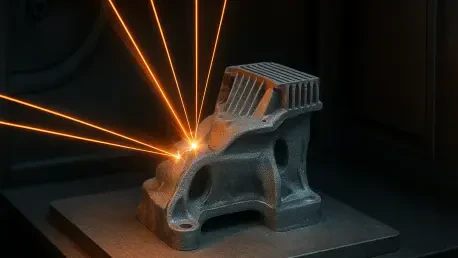
The move toward multi-laser setups reflects a necessary departure from the slow nature of early powder bed fusion. By deploying multiple beams simultaneously, the technology overcomes the physical speed limits of a single galvanometer. This method relies on sophisticated software to coordinate energy delivery across the build plate, turning the system into a collaborative workspace for high-speed material fusion.
Technical Architectures and Performance Drivers
Multi-Laser Configuration and Synchronization
Systems like the EP-M300 use synchronized arrays to distribute workloads across the powder bed. The primary challenge involves managing stitching areas where laser paths overlap to ensure integrity. Precise timing and power calibration are essential to prevent thermal gradients that could lead to part distortion or mechanical failure in the final product.
Operational Throughput and Volumetric Efficiency
Multi-laser systems achieve higher build rates, making large-format components economically feasible. This efficiency requires robust gas flow to clear the increased condensate generated by multiple melt pools. Consequently, reduced build times directly translate to lower costs in industrial environments, making 3D printing a viable alternative to traditional casting.
Innovations in Industrial-Grade Production
Recent advancements focus on technical partnerships that move beyond simple hardware sales. Moreover, providers now offer parameter optimization tailored to specific metal alloys. This ensures that firms can transition to digital production with high repeatability and minimal downtime, allowing for a more strategic approach to equipment acquisition.
Industrial Implementation and Complex Geometries
Aerospace sectors leverage multi-laser systems to produce parts with complex internal cooling channels. These geometries, once impossible to cast, are now manufactured with precision at scale. This capability allows for the consolidation of multiple components into a single assembly, significantly reducing the complexity of global supply chains.
Technical and Market Obstacles
Despite gains, managing consistency in overlap zones remains a technical hurdle. Porosity risks and high capital costs can deter smaller enterprises from adopting these advanced platforms. Ongoing efforts to automate calibration are necessary to lower the barrier for wider industrial adoption across various manufacturing tiers.
Future Trajectory of Metal Additive Manufacturing
The trend points toward systems featuring eight or more lasers to maximize efficiency. Integration of real-time monitoring will likely become standard, utilizing sensors to adjust parameters instantly. This trajectory suggests a move toward decentralized factories producing parts on demand, closer to the point of use.
Final Summary and Technology Assessment
The assessment indicated that multi-laser manufacturing bridged the gap to mass production. Stakeholders recognized the need for standardized certification and modular hardware to sustain long-term growth. These steps ensured a move toward a resilient production model that favored local, high-precision fabrication over traditional logistics.