
The relentless evolution of the global manufacturing landscape has finally reached a point where digital algorithms must bridge the gap into the physical world through tangible machine intelligence. This shift represents a move away from purely abstract data processing toward a model where intelligence is embedded directly into the iron and steel of the factory floor. OMRON Corporation, a global leader in automation based in Kyoto, recently announced its intent to acquire Interlogic, the parent company of the Vermont-based industrial computing specialist OnLogic. This $675 million all-cash transaction stands as a significant milestone, signaling a major strategic leap for both OMRON and the broader industrial computing sector.
By bringing OnLogic into its portfolio, OMRON is redefining the boundaries of what automation can achieve. The deal aims to combine high-precision sensing and control with high-performance industrial computing to create a unified platform. This acquisition is not merely a purchase of assets but a calculated move to secure a dominant position in the emerging field of Physical AI. As the transaction moves toward a planned conclusion in early 2027, the industry is witnessing the birth of a new era where the distinction between hardware and software intelligence begins to dissolve.
A New Era of Intelligence on the Factory Floor
Traditional manufacturing has long relied on static programming where machines follow a predetermined set of instructions with little room for adaptation. However, the modern industrial environment requires a shift toward machine intelligence that can react to the unpredictability of the physical world. The acquisition of OnLogic provides OMRON with the processing backbone needed to transition from simple digital algorithms to a sophisticated system where hardware truly “thinks.” This $675 million investment highlights a growing recognition that the next wave of productivity gains will come from the edge of the network, not just the cloud.
Defining this deal requires looking at the complementary nature of the two organizations. While OMRON is a titan of sensing and control technology, OnLogic has carved out a specialized niche in ruggedized, fanless computing that operates in environments where standard PCs would fail. This merger creates an all-cash foundation for a new kind of automation architecture. By integrating these strengths, the companies are positioned to deliver systems that handle the messy, high-stakes reality of industrial production with the same elegance as a high-speed data center.
The Critical Intersection of Sensing and Computing
Physical AI represents the next great frontier for global manufacturing because it addresses the inherent latency and reliability issues of cloud-based systems. In a high-speed production line, a delay of even a few milliseconds can result in wasted materials or mechanical failure. By moving the “brain” of the operation to the site of the action, manufacturers can process data in real time, allowing for instantaneous adjustments. This intersection of sensing and computing is the only way to meet the rising demand for throughput while simultaneously managing the complexities of modern product variations.
The global landscape is also being reshaped by a persistent labor shortage that shows no signs of abating in 2026. Automation is no longer an optional upgrade but a survival strategy for companies facing a shrinking workforce and rising operational costs. Providing machines with the ability to perceive and respond to their surroundings allows human workers to focus on higher-level supervisory tasks. This evolution ensures that manufacturing remains viable in high-cost regions by maximizing the output of every square foot of the shop floor.
Synergizing Industrial Hardware and Smart Software
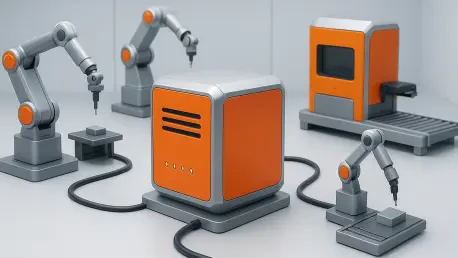
OnLogic’s ruggedized industrial PCs (IPCs) are built to endure the vibration, dust, and temperature fluctuations that define harsh shop floor conditions. These are not merely computers but specialized instruments designed for continuous operation in the field. Integrating these units with OMRON’s programmable logic controllers (PLCs) enables a sophisticated feedback loop. In this configuration, the PLC manages the precise mechanical movements while the IPC runs advanced AI models to monitor quality and optimize energy consumption.
A key driver for modern manufacturing is the move toward customization, often referred to as “build-to-order” flexibility. OnLogic’s business model thrives on this exact principle, offering modular computing solutions that can be tailored to specific industrial needs. This synergy allows for continuous optimization, moving machines away from static execution and into a state of self-learning. Instead of requiring a manual overhaul for every new product iteration, the software can adjust the hardware’s behavior through integrated AI, significantly reducing downtime.
Strategic Rationale: Choosing Ownership Over Alliance
OMRON prioritized a full acquisition over a traditional alliance to maximize its speed to market in a highly competitive AI space. Leadership recognized that a unified technological roadmap is essential for developing the integrated solutions that customers now demand. By owning the hardware stack, OMRON can ensure that its sensing and control software is perfectly optimized for the underlying computing architecture. This level of deep integration is difficult, if not impossible, to achieve through a third-party partnership where goals and timelines might diverge.
Maintaining OnLogic’s agile culture is a central component of the strategic vision. The Vermont-based company will continue to operate as an independent business unit, preserving the innovative spirit that led to its success in the North American market. OMRON intends to leverage its Kyoto-based capital and expansive global supply chain to scale OnLogic’s production capabilities. This combination of American innovation and Japanese industrial might creates a powerful engine for growth that can respond to market shifts more effectively than either entity could on its own.
Practical Implications for the Western Industrial Market
The acquisition is perfectly timed to capture the surge in North American industrial investment. As the world’s second-largest robotics market, the United States has seen a double-digit growth rate in automated installations over the last year. Having a homegrown presence in Vermont allows OMRON to serve European and American customers with localized expertise and faster lead times. This regional footprint is crucial for companies that are re-shoring their production and require partners who understand the specific regulatory and operational nuances of the Western market.
Scaling Physical AI from a pilot program to a full-scale production environment remains a primary challenge for many manufacturers. The OMRON-OnLogic partnership provides a proven framework for this transition, offering the reliability and support needed for long-term deployment. As the companies move toward the 2027 integration, they are laying the groundwork for a digital transformation that is both accessible and robust. This move ensures that the next wave of industrial progress is defined by machines that are as resilient as they are intelligent.
The decision to unify these two entities suggested a bold future for industrial autonomy where the physical and digital worlds merged. Organizations that moved toward this integrated model early realized that the era of siloed machinery had ended. Leadership demonstrated that the path forward required a commitment to hardware that was as intelligent as the software it hosted. This strategic movement paved the way for a more resilient and self-optimizing global supply chain that defined the benchmarks for the decade. Industrial managers identified that scaling Physical AI necessitated a departure from generic computing, and this acquisition provided the necessary specialized solutions.