
The traditional barriers between additive experimentation and industrial-scale production have finally dissolved, revealing a landscape where 3D printing operates as a standard, high-reliability manufacturing tool. Large-format metal production systems are offering a viable alternative to traditional casting by significantly reducing lead times and material waste for mold builders. This shift is evident throughout the exhibits at IMTS 2026, where the emphasis has moved away from simply printing a shape toward the complex requirements of high-volume serial production. By integrating additive manufacturing into a sophisticated ecosystem of automated finishing and digital verification, the industry is meeting the stringent demands of aerospace and medical sectors. The goal is no longer just speed in prototyping but the consistent delivery of certified, mission-critical components that integrate seamlessly into existing factory workflows. This evolution is reshaping how engineers approach design and logistics across the global manufacturing landscape.
Scaling Productivity and Build Volume
Advanced Hardware Architectures: Designing for Throughput
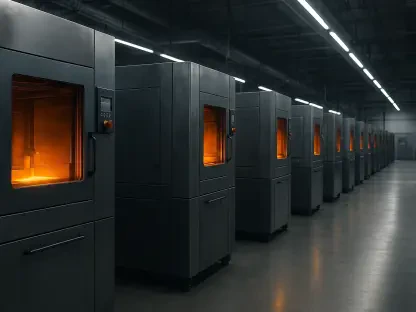
The transition to industrial-scale manufacturing is largely driven by the implementation of sophisticated multi-laser architectures that maximize total throughput. Modern additive platforms now frequently employ a synchronized array of high-power fiber lasers, such as the six 400W laser configuration found in the EOS M4 Onyx, to dramatically increase build speeds. By distributing the thermal load and the scanning workload across multiple points simultaneously, these systems can produce complex geometries in a fraction of the time required by single-laser predecessors. This advancement has effectively bridged the cost gap between additive processes and traditional methods like casting or machining for mid-to-large production batches. Furthermore, the use of advanced beam shaping and intelligent scan strategies ensures that material properties remain consistent across the entire build plate, which is essential for components used in high-stress environments like supersonic engines.
Beyond mere speed, the current generation of hardware focuses on long-term operational reliability and the reduction of manual intervention. Automated job handling and modular build chambers allow for continuous operation, enabling factories to run 24/7 without the downtime typically associated with powder changeovers. Manufacturers have also prioritized the development of more efficient filtration systems, like the RFS Pro technology, which achieves up to 90% powder recovery while eliminating the need for traditional hazardous consumables. This level of automation is critical for shops looking to scale their additive departments into fully functioning production lines that can compete with global machining centers. The integration of high-throughput laser systems with automated logistics ensures that additive manufacturing is no longer a bottleneck but a high-speed engine of production. This structural shift allows for the creation of intricate parts with internal cooling channels that were previously too expensive.
Expanding the Physical Manufacturing Sandbox: Large Format Solutions
The physical limitations of additive manufacturing are being pushed further than ever before through the expansion of build volumes, often referred to as the manufacturing sandbox. This trend toward large-format systems allows for the creation of massive, monolithic components—such as rocket nozzles, satellite frames, and engine housings—that would otherwise require dozens of separate parts and complex assembly processes. By printing these structures as a single unit, manufacturers can significantly enhance structural integrity while reducing the weight associated with joints, fasteners, and welds. The MX3D M1 system, for instance, showcases how wire arc additive manufacturing can produce large-scale metal parts closer to their final near-net shape. This approach not only saves time but also drastically reduces the volume of raw material that must be removed through secondary machining. Consolidating sub-assemblies into a single, high-performance workpiece simplifies the bill of materials.
Expanding the build envelope also introduces new possibilities for the restoration and repair of large industrial equipment. Large-format systems are increasingly being used to add material to worn-out molds and specialized tooling, providing a secondary life for expensive assets that would have previously been scrapped. This capability is particularly transformative for the energy and maritime sectors, where large, specialized parts often face long lead times for replacement. By utilizing robotic additive arms, companies can deposit high-strength alloys onto existing surfaces with extreme precision, followed by localized machining to restore original tolerances. This hybrid approach to maintenance reduces the need for massive inventories of spare parts and allows for on-site repairs that keep critical infrastructure operational. The ability to handle larger workpieces means that additive manufacturing is moving into the heavy industrial space, where it competes directly with the traditional forge.
Ensuring Reliability: Real-Time Analytics and Digital Twins
Digital traceability and real-time process monitoring have become the cornerstone of quality assurance for industrial additive manufacturing. Modern systems are now equipped with an extensive array of sensors—sometimes numbering over 150—that capture data at every layer of the build process. Platforms such as Axtra Insight provide manufacturers with deep analytics, ranging from melt pool stability to oxygen levels and powder distribution. This granular level of detail is necessary for qualifying parts in highly regulated industries like aerospace and defense, where every component must have a verifiable digital birth certificate. By identifying potential defects as they occur, these systems can alert operators to adjust parameters mid-process, preventing the waste of expensive materials and machine time. This predictive maintenance capability ensures that the hardware remains in peak condition, further increasing the reliability of serial production by documenting quality at every step.
The industrial sector reached a milestone where additive manufacturing became a primary pillar of the modern factory, moving beyond its historical role as a secondary process. To maintain this momentum, organizations prioritized the full integration of multi-laser hardware with automated, data-transparent workflows that spanned the entire production lifecycle. This transition required a strategic shift in how engineering teams approached design, focusing on topology optimization and material efficiency to maximize the benefits of the new technology. Leaders in the field validated these high-speed systems for mission-critical applications, ensuring that every 3D-printed component met the same rigorous standards as its traditionally manufactured counterparts. By investing in these connected ecosystems, the industry successfully mitigated supply chain risks and reduced its environmental footprint through material recovery. Looking forward, the next step involved the adoption of autonomous production cells.