
As an agricultural economist specializing in trade dynamics, I have spent decades analyzing the intricate flow of goods across the world’s longest undefended border. The recent upheaval in the North American alcohol market serves as a stark, textbook case study of how decades of diplomatic stability can be dismantled in a matter of months. When $536 million in trade value vanishes almost overnight, it isn’t just a line item on a balance sheet; it represents a fundamental shift in the geopolitical landscape that affects everyone from the vineyard owner in California to the tavern owner in Toronto. This discussion explores the cascading effects of retaliatory tariffs and the deep-seated logistical and psychological shifts occurring as Canada systematically decouples from its traditional reliance on American beer, wine, and spirits.
U.S. alcohol exports to Canada plummeted from $744 million to $208 million in a single year. How does such a rapid market contraction impact the supply chains of American producers, and what immediate logistical steps must they take to pivot toward other international markets?
A contraction of this magnitude—losing $536 million in trade value—is essentially a cardiac arrest for established supply chains. For American wine producers, who saw their exports to Canada crater from $460 million to just $103 million, the shock was immediate because Canada once accounted for roughly 35% of their entire global export market. Logistically, producers were left with millions of gallons of product sitting in warehouses or stuck in transit, forcing them to scramble for emergency storage and deep-discounted secondary markets to avoid total loss. The immediate pivot involves a frantic “rerouting” of shipping containers originally destined for Ontario or Québec toward domestic retailers or emerging markets in Asia and Europe, though these regions often have much higher entry barriers and different labeling requirements. This crisis forced spirits producers, who lost nearly $150 million in Canadian sales, to rethink their “just-in-time” production schedules, as the once stable and low-risk Canadian entry point became a high-risk liability almost overnight.
Provincial liquor authorities have used their power to physically remove specific foreign products from store shelves and digital platforms. What are the operational challenges of managing these state-level trade bans, and how do such aggressive non-tariff measures reshape long-term consumer brand loyalty and purchasing habits?
The operational complexity of these provincial bans is a nightmare for exporters because Canada’s liquor system grants immense, localized power to provincial boards like those in Ontario and British Columbia. When these authorities decided to physically purge American products—sometimes specifically targeting “red” states that supported the administration—it created a vacuum that was immediately filled by domestic and European competitors. For a brand manager, seeing your product literally boxed up and moved to a backroom because of a political spat is a visceral blow that disrupts years of marketing investment. This aggressive “de-listing” forces consumers to break their long-standing habits; when a Canadian shopper can’t find their favorite Napa Valley Cabernet, they reach for a bottle from France or an emerging domestic brand. Over time, this forced experimentation creates a new “taste profile” for the consumer, making the eventual return of the American brand difficult because the emotional and sensory connection has been severed and replaced by a new favorite.
While U.S. wine market share in Canada dropped from 21% to 5%, imports from other global regions rose to fill the gap. How difficult is it for a brand to reclaim “rail spots” once consumers develop a taste for alternatives, and what specific strategies can rebuild that lost trust?
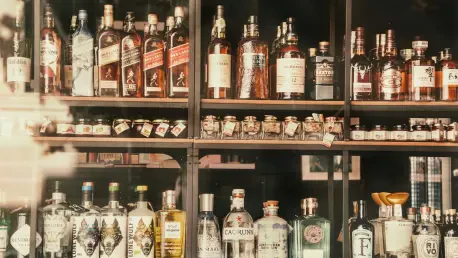
Reclaiming a “rail spot”—the prime real estate in a bar where the most-used spirits are kept—is perhaps the hardest climb in the industry because these positions are built on reliability and consistent pricing. With the U.S. share of the spirits market dropping from 24% to 10% in a single year, independent Canadian bars have “reset the bar,” opting for domestic whiskey or imports from countries that aren’t engaged in a trade war. To rebuild this lost trust, American brands will have to do more than just lower their prices; they will need to launch massive “re-introduction” campaigns that emphasize long-term partnership and stability, which is a hard sell when the threat of renewed tariffs looms. They may also need to invest in localized bottling or joint ventures within Canada to circumvent future trade barriers and signal to Canadian consumers that they are committed to the market regardless of the political climate in Washington. The data shows that while U.S. imports tanked, wine imports from other countries rose by 15%, meaning competitors have already solidified their presence in the minds and glasses of Canadian drinkers.
Agricultural products like barley, grapes, and corn often become primary targets during geopolitical disputes between neighbors. Why are these specific sectors so vulnerable to retaliatory tariffs, and how can farmers better insulate their businesses from the volatility of high-level diplomatic tensions?
Agricultural products are uniquely vulnerable because they are “politically exposed goods” that are often produced in specific geographic regions with high electoral significance, making them perfect targets for retaliatory strikes. When Canada retaliated with 25% tariffs on $30 billion of goods, it intentionally squeezed the farmers who grow the corn and barley for spirits and beer because those farmers have a loud voice in U.S. politics. To insulate themselves, farmers must move toward a strategy of aggressive diversification, ensuring that no single foreign market accounts for a “death-sentence” percentage of their revenue. The step-by-step process for this insulation begins with securing multi-year domestic contracts to create a baseline of stability, followed by participating in export credit insurance programs that protect against sudden political defaults. Finally, agricultural groups must lobby for “trade-neutral” support systems that can pivot crop usage—such as moving corn from ethanol or export to alternative domestic industrial uses—when a sudden 70% drop in trade occurs, as we saw in the alcohol sector.
What is your forecast for the North American alcohol trade?
My forecast for the North American alcohol trade is one of “permanent fragmentation,” where the frictionless, tariff-free era of the past is replaced by a cautious, secondary-source mindset among Canadian importers. Even if the current 25% tariffs are fully rolled back and the diplomatic rhetoric cools, the psychological damage to the supply chain is likely to persist for a decade. Canadian provincial liquor boards have now “stress-tested” their ability to operate without U.S. products and found that they can successfully fill the void with a 9% increase in beer and a 7% increase in spirits from other global partners. We are entering an era where American producers will no longer be the default choice, but will instead have to compete as “foreign” entities alongside European and South American brands who haven’t threatened to absorb Canada as a 51st state. The “new normal” will likely see the U.S. share of the Canadian wine market hover around 8% to 10%, a far cry from the 21% dominance it once enjoyed, as the Canadian “booze habit” has been fundamentally and permanently rewritten.