
The first 40 vehicles produced under this agreement will serve as a vital proof-of-concept for the assembly processes and logistics required for future large-scale operations. This partnership, valued at forty-four million dollars, represents a significant milestone for Aptera as it transitions from prototype development to a standardized manufacturing environment. By securing this funding, the company aims to refine its specialized assembly line, which must accommodate the unique three-wheel configuration and integrated solar skin of the vehicle. Industry experts suggest that the success of these initial units will determine the feasibility of high-volume production schedules slated for the window between 2026 and 2028. This capital injection is not merely a financial boost but a strategic alignment with tier-one suppliers who provide the advanced carbon-fiber composites and high-efficiency monocrystalline silicon cells necessary for the vehicle’s distinct performance profile. Consequently, the focus shifts toward validating every link in the supply chain to ensure quality.
Strengthening Manufacturing Resilience and Production Logic
Resource Allocation and Advanced Robotic Integration
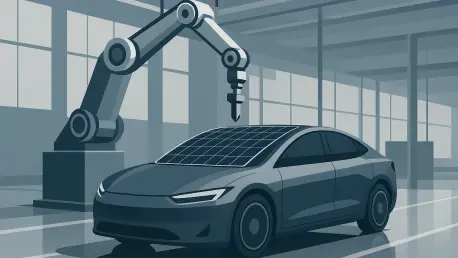
The recent infusion of capital enables the acquisition of specialized robotic arms designed to handle the delicate placement of solar cells onto the vehicle’s curved aerodynamic surfaces. Unlike traditional automotive manufacturing where panels are stamped from steel, these solar electric vehicles utilize a vacuum-infusion process for their composite bodies, requiring a different set of industrial tools and climate-controlled environments. The allocation of funds specifically targets the expansion of a dedicated facility in Carlsbad, where technicians are now implementing a modular assembly approach to maximize space efficiency. This strategy allows the company to bypass the massive overhead costs associated with traditional gigafactories while maintaining a production rate that can be adjusted based on real-time demand. Furthermore, the partnership facilitates the integration of advanced diagnostic software that monitors the performance of each solar panel during the assembly phase, ensuring that every vehicle leaving the line meets strict energy generation standards.
Workforce Development and Specialized Assembly Training
Beyond hardware, the partnership addresses the critical need for specialized labor and expertise in the intersection of aerospace engineering and automotive production. Training programs are currently being established to develop a workforce capable of managing the high-voltage battery systems and the intricate wiring required to channel energy from the solar skin to the drivetrain. This human-centric investment ensures that the assembly line is not only automated but also overseen by professionals who understand the nuances of lightweight structural integrity. As production ramps up between 2026 and 2027, the focus remains on reducing the time-per-unit without sacrificing the structural safety that the carbon-fiber shell provides. The synergy between financial backing and technical mastery allows the organization to tackle the complexities of creating a vehicle that operates almost entirely on ambient light. By optimizing these internal workflows, the manufacturer positions itself to demonstrate that solar-integrated mobility is a viable alternative to plug-in models.
Evaluating Economic Viability and Infrastructure Autonomy
Strategic Market Expansion and Pricing Stability
A major hurdle for specialized electric vehicles has historically been the high cost of entry for early adopters, a challenge this new partnership seeks to mitigate through economies of scale. By securing long-term contracts for raw materials and components, the manufacturer can stabilize pricing despite the volatility often seen in the rare-earth metal and semiconductor markets. The initial 40 units produced will provide the necessary data to optimize the cost-to-production ratio, which is expected to decrease as the facility reaches full capacity by 2027. This financial strategy is designed to make solar-powered mobility accessible to a broader demographic, moving beyond the enthusiast market into the mainstream commuter segment. Lowering the barrier to entry is essential for achieving the volume required to sustain the business model and justify the continued expansion of the manufacturing footprint. As the cost of solar technology continues to fall, the price parity between these vehicles and traditional internal combustion engines becomes a reality.
Long-term Scalability and Environmental Implementation Results
The implementation of the forty-four million dollar partnership successfully bridged the gap between experimental design and commercial reality for solar electric vehicles. By focusing on the first forty proof-of-concept units, the organization established a repeatable and scalable manufacturing process that addressed previous logistical bottlenecks. The strategic allocation of resources into robotic automation and workforce training improved production efficiency, while the technical refinements in solar integration maximized energy harvesting capabilities. This collaboration effectively reduced the dependency on traditional charging infrastructure, offering a glimpse into a world where personal transportation utilized ambient energy sources. Furthermore, the stabilization of the supply chain and the attainment of international safety certifications paved the way for broader market entry and consumer acceptance. Ultimately, the partnership demonstrated that with focused investment and engineering precision, the barriers to mass-producing solar-powered vehicles were surmountable and practical.