
For millions of Americans living without dental insurance, the sudden loss of a tooth or the degradation of an existing bridge represents not just a health crisis but a significant financial catastrophe. In many rural and underserved urban communities, traditional restorative procedures remain prohibitively expensive because of the labor-intensive laboratory processes required to manufacture prosthetic devices. However, the integration of high-speed resin 3D printing and advanced intraoral scanning is currently revolutionizing these clinical workflows by bypassing external labs. This technological shift allows community health centers to produce high-quality crowns, dentures, and night guards in a single visit, reducing the cost of care while improving patient outcomes. By democratizing access to manufacturing, dental professionals are finally closing the gap between cutting-edge oral healthcare and the populations that have been historically left behind by the private insurance market.
Bridging the Accessibility Gap: Digital Innovation
Efficiency in Care: Redefining Clinical Workflows
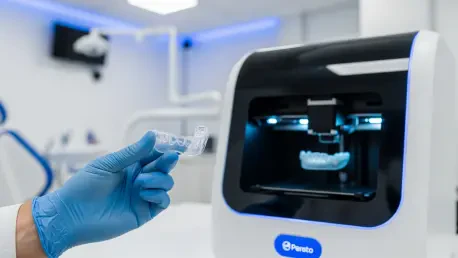
Traditional dentistry has long relied on a supply chain that involves taking physical impressions, shipping them to distant laboratories, and waiting weeks for a finished product. For a patient without insurance, every step in this chain adds a layer of cost that often makes the final bill unattainable, leading many to opt for extractions rather than restorative care. 3D printing technology changes this dynamic by allowing clinics to manufacture dental appliances on-site using biocompatible resins. The transition from subtractive milling—which wastes a significant amount of material—to additive manufacturing ensures that raw material costs remain low. Currently, a resin crown can be printed for a fraction of what a lab would charge for a ceramic alternative. This reduction in overhead enables clinics to offer sliding-scale fees or even pro-bono services to those in desperate need of functional teeth, ensuring that basic restorative work is no longer a luxury for the working poor.
Digital Integration: Removing Barriers to Entry
Beyond the financial benefits, the speed of 3D printing provides a crucial logistical advantage for low-income patients who often face barriers such as lack of transportation or inflexible work schedules. In a traditional setting, a patient would need at least two separate appointments: one for the impression and another for the fitting. With modern digital workflows, an intraoral scan can be completed in minutes, a digital model can be designed in real-time, and the final prosthetic can be printed and cured within an hour. This same-day service model ensures that a patient does not have to sacrifice multiple days of wages or arrange for child care twice. By condensing the treatment timeline, healthcare providers are seeing a significant decrease in “no-show” rates, as patients can receive their complete treatment in a single, efficient visit. This efficiency is proving to be a cornerstone in the modernization of public health dentistry and overall patient retention.
Expanding Reach: The Power of Localized Production
Mobile Solutions: Reaching the Remote Population
Mobile dental units are particularly well-suited to leverage the compact nature of 3D printing hardware to reach isolated rural populations. Previously, these mobile vans were limited to basic cleanings and extractions because they lacked the space and equipment to house a full dental laboratory. Now, a small desktop resin printer and a curing station can be easily integrated into a van’s layout, turning it into a fully functional manufacturing hub on wheels. This allows providers to travel to remote areas and provide comprehensive restorative care in locations where the nearest dental office might be hours away. The ability to offer permanent solutions rather than temporary fixes in a mobile setting is a major breakthrough. It ensures that patients in rural “dental deserts” receive the same caliber of restorative work as those in major metropolitan areas, significantly improving the quality of life and overall systemic health for those in underserved regions.
Strategic Implementation: Future Policy and Training
The successful deployment of 3D printing in community clinics demonstrated that high-tech solutions were the most effective way to address systemic healthcare inequities. To capitalize on these advancements, policymakers and healthcare administrators prioritized the integration of digital labs into state-funded health initiatives. Providing grants for intraoral scanners and biocompatible printers allowed many regions to eliminate waitlists for dentures that had previously stretched for months. Medical schools likewise updated their curricula to ensure that the next generation of dentists was proficient in digital manufacturing. Moving forward, the focus shifted toward establishing national standards for digital dental records to ensure seamless care transitions for transient populations. By investing in these localized production capabilities, society finally moved toward a model where a lack of insurance no longer dictated a person’s ability to smile, speak, and eat with confidence.