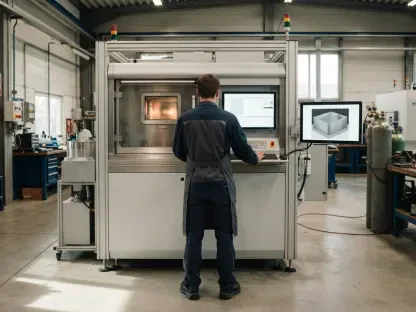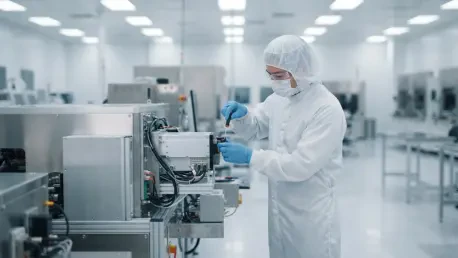

PCB-mounted drives now deliver over one kilowatt of power while occupying a fraction of the space required by traditional remote electrical cabinets in the cleanroom. This technological leap enables tool designers to condense sophisticated electronics into the footprint of the stage itself, drastically reducing the clutter of cabling and external racks that once dominated expensive cleanroom floors. In an industry where a single square meter of production space carries a premium price tag, the ability to integrate high-power control systems directly onto manufacturing equipment represents a paradigm shift in factory efficiency. This evolution is driven by the relentless demand for smaller, more powerful microchips, which requires an unprecedented level of coordination between electronic commands and mechanical execution. As fabrication plants push toward ever-smaller process nodes, the stability and responsiveness of motion systems have become the ultimate gatekeepers of production yield and operational profitability. Achieving this density of power and precision is no longer an optional luxury but a fundamental necessity for maintaining competitiveness in the current global market.
Transitioning to Picometer Precision
As semiconductor process nodes shrink toward the sub-5nm range, the positioning requirements for manufacturing equipment are transitioning from the nanometer scale to the picometer scale. Wafer-handling systems must now manage high-value substrates with virtually zero mechanical shock to prevent damage or contamination from microscopic particles. This transition demands motion stages that can remain perfectly still during high-resolution imaging or move with absolute smoothness to prevent data blurring during critical inspection phases. The challenge lies in the fact that at this scale, even the slightest vibration from a cooling fan or a nearby footfall can disrupt the process. Engineers have responded by developing vibration-isolated platforms that use active cancellation technology, ensuring the wafer remains an oasis of stability amid the chaotic environment of a high-speed factory. These systems utilize advanced air bearings and magnetic levitation to eliminate friction, which is the primary source of heat and unpredictable mechanical behavior in traditional bearing-based systems.
Advanced packaging techniques, such as hybrid bonding and 3D stacking, further increase the complexity of motion control by requiring the precise vertical alignment of multiple dies. These tasks demand synchronized multi-axis control, where several motors work in perfect harmony to create vertical interconnects with tolerances that seem to defy the laws of physics. The ability to maintain this level of coordination determines the ultimate performance and profitability of the manufacturing facility, as even a minor deviation can lead to a failed connection and a discarded wafer. To address this, current systems employ high-bandwidth communication protocols that allow multiple controllers to share data in real time, effectively acting as a single, distributed brain. This synchronization ensures that as one axis moves, the others compensate instantaneously for changes in the center of gravity or mechanical load. The result is a manufacturing environment where the movement of heavy machinery is as fluid and precise as the stroke of a master artist’s brush, enabling the creation of the most complex structures ever built by human hands.
Sophisticated Architectures for Signal Fidelity
Modern motion systems have moved beyond simple feedback loops to utilize sophisticated multilayered architectures that prioritize data integrity and speed. Decoupled control loops are now standard in high-performance drives, allowing for the independent management of current, velocity, and position. This separation enables engineers to fine-tune systems for specific loads and disturbances, ensuring that the mechanical response remains consistent even as environmental conditions change throughout a production shift. By isolating the high-speed current loop from the slower position loop, the system can react to electrical noise without causing jitter in the physical stage. This architecture is particularly effective in vacuum environments where heat dissipation is limited, as it allows for more efficient power delivery and reduced thermal drift. The integration of high-speed digital signal processors ensures that these complex calculations are performed in microseconds, providing a level of responsiveness that was technically impossible just a few years ago.
Field-Oriented Control represents a significant leap in motor efficiency and precision for the brushless motors commonly used in cleanrooms. By transforming motor phase currents into a vectorized direct-quadrature space, this method allows for instantaneous torque management that is perfectly synchronized with the rotor’s magnetic field. This mathematical approach minimizes torque ripple, which is the primary cause of small-scale velocity fluctuations that can ruin a delicate lithography pass. Furthermore, this technique reduces heat generation within the motor windings, which is vital for maintaining the thermal stability of sensitive cleanroom equipment where even a one-degree change in temperature can cause mechanical expansion and alignment errors. By optimizing the efficiency of every watt of power, manufacturers can push their machines to higher speeds without risking the thermal degradation of precision components. This leads to a more sustainable manufacturing process that consumes less energy while producing more high-quality components per hour.
Predictive Modeling and Real-Time Compensation
While traditional reactive controllers respond to errors after they occur, feedforward compensation allows the system to be proactive in its movements. By anticipating the forces required for acceleration and velocity based on the known mass and friction of the stage, the controller reduces the burden on the primary feedback loop. This predictive strategy results in significantly faster settling times, allowing the machine to begin its task almost immediately after reaching its destination. In a high-throughput environment like a modern wafer fab, saving even a few milliseconds on every move can translate into thousands of additional chips produced every month. This proactive approach also extends the lifespan of mechanical components, as the control signals are smoother and less likely to cause the sharp, high-frequency stresses that lead to material fatigue. The transition from reactive to predictive control represents a fundamental shift in how engineers view motion, moving from a philosophy of correction to one of prevention.
To further refine performance, engineers employ table-based compensation to address position-specific mechanical variations that are inherent in any physical structure. If a stage encounters slight changes in friction or compliance at a certain point in its travel due to a minor rail misalignment or varying cable weight, a lookup table adjusts control parameters in real-time. This ensures that the motion remains uniform across the entire range of travel, regardless of mechanical imperfections that would otherwise limit the system’s accuracy. These tables are often generated during an initial calibration phase where the machine uses an external laser interferometer to map its own inaccuracies. Once the map is created, the controller uses it to “see” the upcoming hurdles and adjust its power output accordingly. This software-driven approach to precision allows manufacturers to achieve extreme levels of accuracy without requiring the impossible task of building a mechanically perfect machine. It is a testament to the power of modern computing that software can now compensate for the unavoidable flaws of the physical world.
Mitigating Mechanical Resonance in Dynamic Systems
Mechanical resonance poses a constant threat to precision, as vibrations can interfere with delicate processes like chemical vapor deposition or atomic layer etching. By using frequency-domain analysis and Bode plots, engineers can identify the specific frequencies at which a system is prone to oscillate based on its unique physical geometry and material properties. Once these points are mapped, active filtering techniques are used to suppress unwanted vibrations before they can affect the manufacturing process. This is a critical step in the commissioning of any high-precision stage, as every machine has a unique vibration signature that must be tamed. The goal is to create a control system that is “blind” to these resonance points, ensuring that the motor never injects energy into the system at a frequency that would cause it to shake. This results in a stage that feels incredibly stiff and responsive to commands while remaining silent and still when not in motion.
The use of dual biquad filters allows controllers to “notch out” specific resonant frequencies with surgical precision before they can impact motion. This active filtering ensures that the stage remains stable and that ambient noise, such as the hum of a facility’s air conditioning system, does not degrade the quality of the silicon wafers. Such filtering is essential for maintaining the integrity of high-resolution sensor data and the precise placement of lithographic masks, which require an almost incomprehensible level of stillness. By stacking multiple filters, engineers can address complex mechanical structures that have several resonance modes, effectively smoothing out the entire frequency response of the system. This allows for higher gain settings in the control loop, which in turn leads to better tracking of the desired path and a faster response to external disturbances. The result is a system that is both incredibly fast and remarkably stable, a combination once considered a physical contradiction.
Efficiency Gains Through Advanced Profile Shaping
The specific path of acceleration, known as the motion profile, determines how much energy is injected into the mechanical structure of the fabrication tool. Traditional trapezoidal profiles often cause jerky movements due to instantaneous changes in acceleration, which are often referred to as “infinite jerk.” These sharp transitions excite higher harmonics within the machine frame, leading to vibrations that require a lengthy settling time before the next process step can occur. This downtime is a major bottleneck in semiconductor manufacturing, as the machine sits idle while waiting for the physical oscillation to die down. By smoothing out these transitions, manufacturers can increase the overall speed of their production lines without sacrificing the quality of the finished product. The shift toward more sophisticated profiles is a direct response to the need for higher throughput in an industry that is constantly struggling to meet global demand for microelectronics.
In contrast, S-curve profiles use a jerk-limited approach where acceleration increases and decreases gradually, mimicking the natural movement of a human hand. Research and field testing indicate that dedicating even a small fraction of the movement time to these smooth transitions can dramatically reduce mechanical resonance across the entire system. This leads to shorter overall cycle times, as the equipment can stabilize almost instantly upon reaching its target position, allowing the lithography or inspection process to begin without delay. Modern controllers can calculate these complex curves in real time, adjusting the “smoothness” of the move based on the specific requirements of the task. For example, a non-critical transport move might use a faster, more aggressive profile, while a sensitive inspection move would switch to a highly damped S-curve. This flexibility allows a single piece of equipment to perform a wide variety of tasks with optimal efficiency, maximizing the return on investment for the factory owner.
Miniaturization and the Rise of Integrated Stages
A major shift is occurring in equipment design toward integrated architectures, moving the controller and drive electronics closer to the actual point of motion. Traditionally, these components were housed in distant electrical cabinets, necessitating long and bulky cables that were prone to picking up electromagnetic interference. By placing the drive electronics directly on the positioning stage, manufacturers can significantly improve signal integrity and ensure that the high-resolution encoder data reaches the controller without being corrupted by noise. This “SmartStage” approach also simplifies the overall mechanical design by eliminating complex cable tracks that can introduce unwanted drag or mechanical bias. As cables move and flex, they exert a variable force on the stage that can be difficult to compensate for; by minimizing the cable count, this source of error is effectively removed. This clean, integrated design is also much easier to maintain and troubleshoot, as the entire motion system is contained within a single, modular unit.
The miniaturization of high-power electronics has been a key enabler of this trend, allowing for PCB-mounted drives that provide the same performance as their cabinet-sized predecessors. Given the astronomical cost of cleanroom floor space, increasing the density of tools within a fabrication facility provides a direct boost to manufacturing capacity and cost-efficiency. Designers can now fit more processing stations into the same area or reduce the overall footprint of the facility to save on construction and utility costs. This integration also leads to a more robust system, as there are fewer connectors and cables that can fail over time. In the harsh environment of a semiconductor fab, where machines run 24/7 for years at a time, this increased reliability is a significant advantage. The transition to integrated motion is a clear example of how improvements in electronic component technology are directly impacting the physical design and efficiency of industrial machinery.
Ensuring Reliability Through Thermal Intelligence
In an industry where downtime is measured in hundreds of thousands of dollars per hour, system reliability is a paramount concern for every operator. Smart motion monitoring has evolved to include comprehensive thermal diagnostics that protect against motor failure before it occurs. Systems now use mathematical modeling to track energy consumption and predict temperature rises in real time, rather than relying on simple thermometers that react too slowly. This proactive thermal management allows the system to adjust its performance dynamically—perhaps by slowing down slightly during a particularly hot afternoon—to ensure that the equipment never reaches a critical failure point. By understanding the thermal limits of every component, the controller can operate right at the edge of maximum performance without ever crossing into the danger zone. This provides the best possible throughput while maintaining a high level of safety for expensive manufacturing equipment.
This modeling acts as a virtual fuse, allowing for short-term power boosts during rapid moves while preventing long-term thermal overload that could damage sensitive motor insulation. By correlating electrical current with temperature through an I-squared-t calculation, the system can maintain 24/7 operation without the need for excessive, bulky cooling hardware that would take up valuable space. High-speed sensing further protects the system by reacting to electrical anomalies, such as a short circuit or an undervoltage condition, in a matter of nanoseconds. This level of protection is essential for preserving the integrity of the high-value wafers being processed, as a sudden loss of control could result in a mechanical crash and the destruction of the substrate. The combination of electrical and thermal intelligence ensures that the motion system is not just a blind actuator, but a self-aware component capable of protecting itself and the product it carries.
High-Fidelity Feedback and Sensor Innovation
The accuracy of any motion system is fundamentally limited by the quality of its feedback sensors, leading to a rapid transition toward high-speed serial interfaces. Traditional encoders, which rely on pulse-based quadrature signaling, are often limited by noise and the maximum frequency the controller can process. Modern serial protocols provide absolute position data with incredible resolution, allowing the controller to determine exactly where the stage is upon power-up without needing a homing routine. This increases system safety and efficiency by reducing the risk of collisions and speeding up the recovery process after a power interruption. Furthermore, these digital interfaces are much more resistant to electromagnetic interference, which is a constant presence in the complex electrical environment of a modern factory. The move toward digital feedback is a key part of the broader trend toward the digitization of the entire manufacturing process.
Advanced signal processing has pushed these sensors to achieve resolutions as low as 300 picometers, providing the high-fidelity data required for nanometer-scale tasks. This level of precision, which approaches the scale of individual atoms, is absolutely necessary for aligning masks in modern lithography or inspecting the ultra-fine traces on a high-end microchip. Whether using optical encoders that rely on the interference patterns of light or robust magnetic sensors that can withstand harsh chemical environments, these feedback technologies are the eyes of the motion system. The ability to measure position with such extreme accuracy allows the controller to make tiny corrections that keep the process on track, even in the presence of external disturbances. As the industry moves toward even smaller features, the demand for higher resolution and faster data rates will continue to drive innovation in sensor technology, ensuring that the “eyes” of the machine remain as sharp as the “brain” that controls them.
Strategic Shifts in Semiconductor Production Infrastructure
The future of the semiconductor industry lies in the co-design of actuators and control electronics, where physical and digital components are developed in tandem. Rather than assembling disparate parts from different vendors, engineers are now designing mechanical structures and electronic controllers together to optimize the overall dynamics of the system. This holistic approach ensures that the stiffness of the stage is perfectly matched to the bandwidth of the controller, maximizing the performance of both. Additionally, hybrid technologies like closed-loop steppers are gaining traction for less critical transport tasks, providing a cost-effective alternative to expensive brushless systems. By adding high-resolution encoders to traditional stepper motors, manufacturers can achieve servo-like precision and reliability at a much lower price point. This allows for a more efficient allocation of capital resources, focusing the most expensive technology where it is most needed, such as in the core lithography and metrology stations.
The implementation of these advanced motion strategies provided a clear path forward for manufacturers facing the challenges of the sub-5nm era. By adopting integrated architectures and predictive control algorithms, leading firms successfully reduced their floor space requirements while simultaneously increasing their production yield. The transition to high-resolution serial feedback and active vibration filtering allowed for a level of precision that was once thought to be physically impossible. Moving forward, the industry realized that the key to future success lay in the continued convergence of mechanical engineering, software development, and power electronics. To stay competitive, companies must prioritize the integration of smart diagnostics and co-designed hardware to ensure their facilities remain resilient in the face of rising global demand. The strategies developed during this period established a new baseline for what is achievable in precision manufacturing, setting the stage for the next decade of electronic innovation.