
A massive industrial shift is currently rewriting the rules of the European labor market as the silent whir of humanoid joints begins to echo through the expansive halls of sophisticated data factories. This transition marks the end of an era where artificial intelligence was confined to digital chatbots and the beginning of a period defined by embodied intelligence. The strategic alliance between semiconductor leader AMD and robotics pioneer Generative Bionics represents a decisive step in this evolution. By combining high-performance computing with advanced humanoid design, these organizations are laying the foundation for a physical AI infrastructure that aims to redefine how the world approaches manufacturing and automation.
The emergence of these physical data factories is more than a technological milestone; it is a fundamental restructuring of the industrial landscape. For decades, automation was synonymous with stationary robotic arms performing repetitive tasks in isolation. Today, the focus has shifted toward humanoid robots that can navigate complex, human-centric environments and adapt to unpredictable variables. This partnership addresses the critical need for specialized environments where these machines can be trained, refined, and validated at scale. As these facilities become operational, they will serve as the engine for a new generation of industrial capability that prioritizes flexibility and intelligent interaction.
Redefining Global Industrial Leadership Through Physical AI
The shift from digital-only interfaces to embodied intelligence represents a paradigm shift in how society interacts with technology. While previous AI breakthroughs focused on processing text and images, physical AI requires a deep understanding of physics, spatial awareness, and tactile feedback. The collaboration between AMD and Generative Bionics is specifically designed to bridge this gap, moving beyond the limitations of virtual models. By creating a dedicated infrastructure for humanoid development, the partners are ensuring that the intelligence governing these machines is as robust and reliable as the hardware itself.
This strategic alliance leverages the complementary strengths of both organizations to create a seamless pipeline for robotic innovation. AMD provides the massive computational power required to process vast amounts of sensory data, while Generative Bionics focuses on the intricate mechanics and control systems of the humanoid form. Together, they are building a sovereign European infrastructure that allows for the localized development of humanoid robotics. This localized approach is essential for maintaining control over the intellectual property and technical standards that will govern the future of the continent’s manufacturing sector.
The Urgency of European Technological Sovereignty
In the current global landscape, the dominance of China and the United States in industrial automation has created a sense of urgency for European leaders. Last year, in 2025, China alone accounted for nearly 60% of the world’s industrial robot installations, leaving other regions to play a difficult game of catch-up. To counter this, Generative Bionics and AMD are championing the concept of the “Physical AI Stack.” This framework is designed to ensure that the data, the models, and the physical training grounds remain under European control, providing a secure foundation for industrial growth.
The decline in robot installations across major European markets has highlighted the need for a more aggressive approach to technological independence. The flagship 5,000-square-meter facility in Italy is a direct response to this challenge, serving as a hub for innovation and a symbol of European resilience. This facility is tasked with producing the high-quality data necessary to train robots that are tailored to the specific needs of European industries. By establishing these data factories, the partnership is working to ensure that the continent does not become a mere consumer of foreign technology but remains a primary architect of its own industrial future.
Engineering Intelligence With AMD Helios Architecture
One of the most significant hurdles in the development of humanoid robotics is the problem of “data poverty.” Unlike language models that can be trained on the internet’s vast digital archives, physical robots require data that simply does not exist in large quantities. To solve this, the partnership utilizes the AMD Helios architecture to power massive digital-twin simulations. These simulations allow robots to practice millions of movements and interactions in a virtual environment before they ever step onto a physical factory floor. This real-to-sim-to-real cycle is essential for accelerating the learning process.
The AMD Helios system provides the necessary throughput to run these complex simulations in parallel, effectively compressing years of training into weeks. These simulations are not just visual; they incorporate detailed physics engines that replicate gravity, friction, and material properties. Through this process, engineers can develop World Action Models that predict how a robot should react to a wide variety of industrial scenarios. This computational backbone ensures that when a robot like the GENE.01 is finally deployed, it possesses a level of situational awareness that was previously impossible to achieve through manual programming alone.
Validating Humanoid Performance in Data Factories
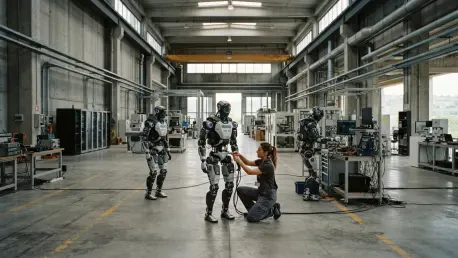
The Italian hub, which is scheduled to reach full operational capacity by 2027, serves as a high-tech training ground where simulated intelligence meets the physical world. Within this facility, the GENE.01 humanoid undergoes rigorous testing in environments that meticulously replicate real-world factory conditions. This setup allows for a continuous feedback loop where data from physical performance is used to refine the digital simulations. By testing robots in these controlled yet realistic settings, the team can ensure that each unit is prepared for the complexities of a functioning production line.
Scaling this network of data factories is a core part of the long-term strategy for European and global markets. The success of the Italian flagship will provide a blueprint for future sites, enabling the rapid expansion of physical AI infrastructure. Each new site will contribute to a growing library of physical data, further enhancing the capabilities of the robotic fleet. This systematic approach to validation not only improves the safety and efficiency of individual robots but also builds the collective intelligence of the entire network, creating a scalable model for industrial autonomy.
Powering Innovation Through Strategic Capital and Partnerships
The financial foundation for this ambitious project was solidified through a €70 million seed round led by CDP Venture Capital. This significant investment, which included participation from AMD Ventures and other strategic partners, underscores the high level of confidence in the potential of physical AI. Beyond capital, the project is bolstered by deep industrial collaborations with major players in shipbuilding and energy. For example, the partnership with Fincantieri is focused on developing robots capable of assisting with complex welding tasks, while the collaboration with Eni explores the use of humanoids for remote site inspections.
These partnerships provide the real-world contexts that are necessary for specialized training. By working with industry leaders, Generative Bionics can identify specific pain points and develop targeted solutions that offer immediate value. The roadmap for the next several years includes a focus on welding assistance and teleoperation, areas where humanoid robots can significantly improve safety and productivity. The combination of strategic capital and practical industrial application ensures that the technology being developed is not just a laboratory curiosity but a viable solution for the modern global economy.
Implementing Physical AI in Modern Industrial Workflows
The strategic implementation of these humanoid units within industrial workflows is viewed as a watershed moment for the region. It was determined that the use of multimodal skin sensors effectively bridged the safety gap between humans and machines. Engineers observed that high-performance computing clusters provided the necessary throughput for rapid model refinement, which ultimately allowed the robots to adapt to shifting production demands. This transition was marked by a newfound confidence in domestic manufacturing capabilities, ensuring that the robotic workforce remained an asset of the local economy rather than a product of foreign dependence.
By prioritizing data sovereignty, the partnership successfully established a blueprint for future autonomous systems that prioritize local control and security. The project demonstrated that European manufacturing could indeed undergo a radical transformation while maintaining its core values and economic independence. Stakeholders concluded that the successful deployment of these data factories provided the essential infrastructure required to sustain a high-tech industrial base. As the initial training cycles were completed, the focus shifted toward the continuous optimization of these systems to meet the evolving challenges of the global market.