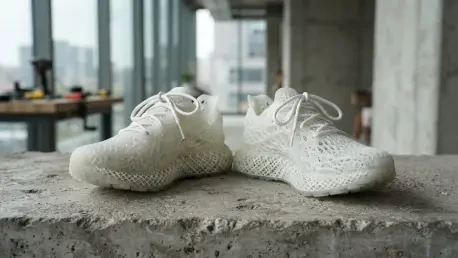

Modern additive manufacturing allows for the creation of footwear based on gyroid models, which are mathematically derived structures known for their high strength-to-weight ratios. In 2026, the global shoe industry is witnessing a profound shift as brands move away from traditional assembly lines toward integrated, single-process production methods. Researchers at Dong-A University have recently demonstrated the viability of this approach by developing a complete shoe printed entirely from a specialized microfoamed filament. This method eliminates the need for gluing and stitching disparate components like outsoles and uppers, which has long been a bottleneck in both speed and sustainability. By focusing on a material–process–structure–performance framework, engineers can now fine-tune the mechanical properties of a shoe at every cubic millimeter. This innovation is not merely about aesthetic customization; it is about engineering footwear that behaves like an extension of the body, reacting to the unique gait and weight of the individual wearer.
Advanced Material Characterization and Optimization
Understanding Microfoamed Filament Properties: The Thermal Foundation
The core of this breakthrough lies in the rheological behavior of microfoamed thermoplastic polyurethane (TPU), which performs significantly differently than standard filaments under the intense heat of a 3D printer nozzle. Using advanced loss factor measurements, or tan delta, the research team analyzed how these materials transition between viscous and elastic states. It was found that the microfoamed variants maintained much better shape retention at temperatures exceeding 180 degrees Celsius compared to their dense counterparts. This thermal stability is crucial because it prevents the delicate lattice structures from sagging or collapsing while they are being extruded layer by layer. When a material can maintain its structural integrity during the liquid-to-solid transition, the resulting shoe maintains much tighter tolerances. This ensures that the internal air pockets created by the foaming agents remain intact, which is the primary reason why these shoes can remain so lightweight without losing their durability.
Further investigation using differential scanning calorimetry (DSC) highlighted the unique thermodynamic profile of microfoamed TPU, which exhibits dual melting peaks rather than a single point of failure. These peaks, occurring at 159.70 and 194.37 degrees Celsius, represent the complex endothermic reactions of the microscopic foaming agents as they expand within the polymer matrix. The enthalpy of the foamed material was recorded at a mere 3.47 J/g, which is a massive reduction from the 11.52 J/g found in standard dense TPU filaments. This change in energy density is a clear indicator of how the internal morphology of the plastic has been fundamentally altered. These thermodynamic signatures are not just scientific curiosities; they prove that the material has been successfully transformed into a porous, energy-efficient medium. By understanding these thermal boundaries, manufacturers can optimize print speeds and nozzle temperatures to ensure that every part of the shoe, from the heel to the toe box, has a consistent and reliable density.
Optimizing the Printing Architecture: Geometry and Orientation
To transform these materials into a functional product, researchers utilized a gyroid architecture, which is a complex, non-intersecting surface that maximizes internal volume while providing immense structural support. The shoes were designed with a 20 percent infill density using a zigzag pattern, striking a perfect balance between material savings and mechanical strength. This specific geometry allows the shoe to act as a singular, cohesive spring that can compress and rebound with every step. Unlike traditional foams that can break down over time, a 3D printed gyroid maintains its geometric memory because the support is distributed evenly across a continuous surface. This level of mathematical precision in footwear design was previously impossible with conventional molding techniques. By applying these models, designers can create sections of varying stiffness within the same print job, allowing for a firmer heel and a softer forefoot without the need for multiple material injections or manual assembly.
A critical technical hurdle addressed in this research was the optimization of the print orientation, which determines how the layers bond and resist force. After testing various angles, it was determined that a 45-degree tilt was the most effective configuration for printing a full-sized shoe within the build volume of a standard dual-nozzle FDM printer. While this orientation requires additional support material and extends the total production time, it creates a diagonal stacking of layers that is inherently superior at distributing bending stresses. In a traditional horizontal print, the layers are prone to delamination when the shoe flexes at the ball of the foot. However, the 45-degree arrangement spreads these loads across a larger surface area of inter-layer bonds, significantly reducing the risk of structural failure. This diagonal architecture effectively turns the entire shoe into a three-dimensional truss system, ensuring that the footwear can withstand the repeated pivoting and flexing inherent in athletic movement.
Mechanical Performance and Human Factors
Weight Reduction and Compressive Strength: Performance Metrics
The mechanical testing phase revealed that microfoamed TPU is a game-changer for weight reduction, with the finished shoe weighing approximately 133 grams, nearly 30 percent lighter than rigid alternatives. In compression tests, the material demonstrated a remarkable ability to deform without breaking, achieving a maximum strain of nearly 83 percent. This flexibility is a direct result of the 50-micrometer pores embedded within the filament, which allow the cell walls to buckle and absorb pressure. While standard PLA shoes proved to be brittle and reached their limit at only 25 percent strain, the microfoamed TPU shoes remained functional even under extreme loads. This high compressive toughness means that the footwear can absorb the kinetic energy of a heavy footfall and slowly dissipate it, rather than reflecting that energy back into the user’s joints. This mechanical response is essential for preventing long-term stress injuries, as it provides a cushioned landing that mimics the natural fat pads of the human foot.
Impact attenuation is another area where these 3D printed structures outshine traditional materials, as evidenced by rigorous tests following international safety standards. Using a series of 5-joule drop impacts, researchers found that the microfoamed TPU heel could progressively reduce energy across multiple rebound peaks. While rigid PLA structures showed dangerously high peak loads of nearly 689 Newtons, the microfoamed shoes kept these loads closer to 477 Newtons. This lower peak load indicates that the shoe is doing the work of absorbing the impact rather than the wearer’s skeletal system. The stability of the load-displacement curves during these tests suggests that the material does not fatigue quickly, maintaining its protective qualities even after repeated use. This level of shock absorption is comparable to high-end commercial athletic midsoles, yet it is achieved through a single, printed structure. This performance profile proves that additive manufacturing can move beyond prototyping and into the production of high-performance safety gear.
Ergonomic Validation: The Path to Market Readiness
Human-centric trials provided the final layer of validation, showing how these printed shoes interact with the complex geometry of the human foot during motion. By measuring plantar pressure, researchers discovered that the microfoamed TPU shoes significantly reduced the peak pressure in the metatarsal and heel regions. For instance, pressure in the second metatarsal zone dropped from over 3 kPa/kg when barefoot to roughly 2.10 kPa/kg when wearing the 3D printed shoes. This reduction is primarily due to the way the foamed structure allows the foot to sink into the material, creating a more uniform distribution of weight. By expanding the contact area between the sole and the shoe, the design eliminates “hot spots” where high pressure often leads to blisters or chronic pain. The ability to customize this pressure distribution by simply adjusting the digital model offers a revolutionary tool for podiatrists and athletes who require specific orthopedic adjustments to their footwear for daily comfort.
The transition toward fully printed footwear necessitated a shift in how designers approached long-term durability and industrial scalability. Moving forward, the industry adopted foot-scanning technologies to ensure that every gyroid structure was perfectly calibrated to the wearer’s unique anatomy. It was observed that while the microfoaming process provided excellent comfort, the next stage of development required focusing on abrasion resistance and surface traction for outdoor environments. Engineers looked toward multi-material printing to integrate more durable outsoles directly into the microfoamed structure. The research conducted by the team at Dong-A University successfully bridged the gap between material science and ergonomic design, proving that a single-structure shoe could compete with traditional multi-component sneakers. This study paved the way for a more sustainable, decentralized manufacturing model where shoes were printed on demand, reducing waste and ensuring a perfect fit for every user.