
The transition toward ubiquitous 5G networks has fundamentally redefined the relationship between modern passenger cars and the digital environments through which they navigate daily. While previous generations of cellular technology offered basic telematics and slow data uploads, the deployment of mid-band and millimeter-wave frequencies has enabled a level of throughput that was previously restricted to wired fiber-optic connections. This evolution allows vehicles to process gigabytes of sensor data in real time, moving beyond simple GPS navigation to sophisticated environmental awareness. Modern automotive architectures now treat the vehicle as a mobile edge computing node, capable of communicating with traffic signals, pedestrians, and other motorists within milliseconds. The shift has effectively turned highways into intelligent ecosystems where information flows as fluidly as the traffic itself. This connectivity serves as the bedrock for the next phase of mobility, ensuring that every turn and brake application is informed by a global network of data.
The Evolution: Cellular Vehicle-to-Everything Communication
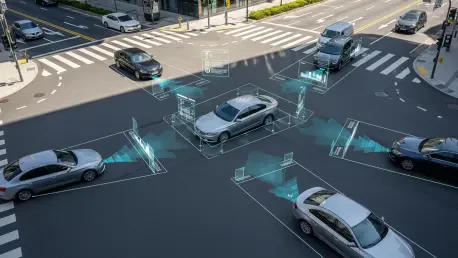
The architecture supporting Cellular Vehicle-to-Everything, or C-V2X, represents a departure from traditional dedicated short-range communications by leveraging the wide-reaching 5G footprint to create a unified ecosystem. By utilizing the 5G New Radio standard, automotive manufacturers like Ford and Audi have begun integrating transceivers that handle both direct short-range communication and long-range network-based interactions simultaneously. This dual capability ensures that a car can receive an emergency alert from a vehicle three cars ahead while also downloading high-definition map updates from a remote server. The ultra-reliable low-latency communication feature of 5G is particularly vital here, as it reduces transmission delays to less than ten milliseconds, which is faster than human reaction time. Such speeds are essential for collaborative maneuvers, where multiple vehicles must synchronize their speeds to merge into traffic or navigate complex intersections safely.
The integration of 5G facilitates a concept known as collective perception, where vehicles share their localized sensor views—such as LiDAR and camera feeds—with others in the vicinity to eliminate blind spots. When a vehicle equipped with advanced sensors detects a pedestrian obscured by a parked truck, it can broadcast that visual data to surrounding cars via the 5G network, allowing them to brake before the hazard even enters their line of sight. This level of cooperative sensing drastically increases the safety margins for both human-driven and autonomous vehicles, as it extends the operational vision of the car far beyond the range of its onboard hardware. Furthermore, the high bandwidth of 5G allows for the streaming of raw sensor data to edge servers for rapid processing, which supports complex decision-making processes without requiring massive, heat-generating computers inside every car. This offloading of computational tasks makes safety features more accessible across various vehicle models.
Strategic Implementation: Building the Infrastructure for Tomorrow
The shift toward a fully connected automotive landscape required a coordinated effort between telecommunications providers, automotive engineers, and government regulators to standardize communication protocols. Stakeholders focused on the deployment of small-cell technology along major transit corridors to ensure continuous 5G coverage, which eliminated the dead zones that previously hindered reliable vehicle-to-network communication. Manufacturers moved away from proprietary, closed-loop systems in favor of open-source architectures that allowed for cross-brand interoperability, ensuring that a Volvo could talk to a Toyota without technical barriers. This collaborative approach prioritized the creation of a secure, encrypted framework to protect vehicle data from cyber threats while maintaining the high speeds necessary for safety-critical applications. By investing in resilient hardware and flexible software platforms, the industry laid the groundwork for a system that could adapt easily to future needs.
Organizations recognized that the success of connected mobility depended on a proactive stance toward data privacy and the ethical management of the massive information streams generated by millions of vehicles. Policymakers established clear guidelines for data anonymization, which allowed for the sharing of traffic patterns and safety alerts without compromising the personal privacy of individual drivers or passengers. This regulatory clarity encouraged private investment in edge computing facilities, which further reduced the physical distance data had to travel, thereby enhancing the overall efficiency of the network. Moving forward, the focus shifted toward integrating renewable energy sources with the 5G grid to power the roadside units and data centers that sustained this intelligent transportation system. By aligning technological advancement with environmental sustainability, the industry demonstrated a commitment to a holistic vision of transit that was both high-tech and ecologically responsible.