
The dusty, pothole-riddled streets of urban India are witnessing a quiet revolution where rugged utility is finally trumping the fragile elegance of traditional electric scooters. When a startup in the hyper-competitive Indian electric vehicle ecosystem secures a massive $120 million investment in an oversubscribed round, the news reverberates far beyond the boardroom. It signals a fundamental turning point for the entire industry, moving away from niche experimentation toward scalable, industrial-grade solutions. River Mobility’s Series C funding stands as one of the largest private infusions into the electric two-wheeler sector to date, providing more than just capital for operations. This financial landmark validates a specific, utilitarian vision for urban mobility that prioritizes ruggedness and practical design over the flashy aesthetics that once dominated the market. This development indicates that the industry is no longer satisfied with being a minor alternative; it is positioning itself to lead a global shift in personal transport.
A Paradigm Shift in Indian Two-Wheeler Financing
This capital injection represents a departure from the traditional venture capital model that prioritized user acquisition over long-term infrastructure. By attracting a diverse group of investors, the company has demonstrated that the Indian electric vehicle sector is ready for sophisticated financial structures involving both equity and venture debt. This mix allows for long-term strategic growth while maintaining the liquidity necessary to navigate the capital-intensive nature of vehicle manufacturing. The funding is not merely a survival kit but a war chest designed for aggressive expansion in an environment that has become increasingly wary of high-burn business models.
The oversubscription of the round highlights a significant appetite for stable, hardware-centric businesses that offer tangible solutions to urban congestion. This shift in financing suggests that the era of speculative investments is giving way to a more grounded approach where industrial capability is the primary metric of value. Investors are now looking for companies that can prove their worth on the tarmac, ensuring that the next generation of transport is built on a solid fiscal foundation. By securing these funds, the manufacturer has set a new benchmark for how domestic startups can leverage global interest to solve local problems.
Beyond the Hype: The Real-World Stakes of the Electric Transition
The Indian market is currently navigating a critical transition from an era defined by early adopters and experimental prototypes to a phase of mass-market maturation. For years, the primary focus remained on high-performance “sporty” models or basic, flimsy commuters that struggled with the rigors of local infrastructure. River Mobility identified a significant gap in what is now termed the “utility lifestyle” segment, targeting users who require a vehicle that functions as a dependable tool. This segment addresses the practical reality that an electric scooter must carry groceries, transport children, and navigate monsoon floods without faltering.
This distinction is vital because the success of the broader electric transition depends on vehicles capable of handling diverse road conditions and heavy cargo. As global industrial titans like Yamaha Motor Corporation join forces with local financial institutions, the stakes have shifted from mere survival to achieving national accessibility. This movement is no longer about proving that electric vehicles work; it is about proving they can replace the internal combustion engine across every demographic and use case. The maturity of the market is evidenced by this focus on durability and real-world performance over theoretical speed or high-tech gimmicks.
Scaling the Utility Lifestyle: Product Innovation and Infrastructure
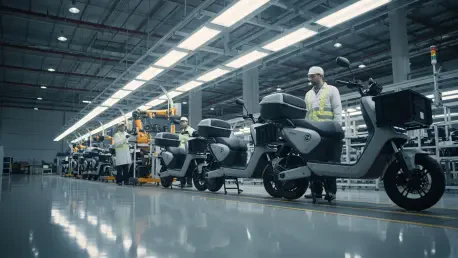
Allocation of the $120 million is strategically divided between immediate retail expansion and the construction of long-term industrial capability. A central pillar of this plan is the establishment of a “greenfield” manufacturing plant, which allows for the creation of production lines optimized specifically for electric drivetrains from the ground up. This avoids the inefficiencies of retrofitting older facilities and ensures that the manufacturing process is as innovative as the product itself. The facility represents a commitment to high-volume output that can meet the growing demand of a rapidly electrifying nation.
While current operations maintain a steady monthly volume, the roadmap calls for a massive retail footprint expansion, growing from 75 stores to more than 350 by March 2028. This growth focuses on the “utility lifestyle” hardware, emphasizing massive storage capacity and extreme durability. By treating the vehicle as a reliable asset for both personal errands and professional logistics, the company is anchoring its growth in the daily necessities of the Indian consumer. Physical presence in more cities will demystify electric mobility for the average buyer, providing the hands-on experience necessary to drive widespread adoption.
Institutional Backing and the Global Validation of Local Tech
The diversity of the investor pool—comprising venture debt firms and strategic equity partners—offers a high degree of credibility to the domestic technology stack. The involvement of Yamaha Motor Corporation provides a unique layer of technical synergy, potentially granting access to global manufacturing standards and world-class engineering precision. This partnership serves as a bridge between Indian innovation and international industrial expertise, elevating the quality of locally produced electric vehicles. Such global validation is crucial for establishing India as a primary hub for electric two-wheeler manufacturing.
Simultaneously, the entry of domestic institutional giants like HDFC AMC and 360 ONE Asset indicates that the Indian financial establishment now views the electric vehicle sector as a stable, long-term asset class. This transition from high-risk venture territory to institutional-grade investment suggests a maturing ecosystem where technical viability and market demand are finally in sync. The presence of these heavyweights provides a buffer against market volatility and ensures a steady flow of capital for future research and development. It signals to the broader economy that the electric transition is now a permanent fixture of the industrial landscape.
Pathways to Profitability and Supply Chain Autonomy
To translate this funding into sustainable success, the strategy focuses on operational self-reliance and vertical integration. By investing in its own manufacturing plants, the company aims to reduce dependence on imported components and the unpredictable nature of global supply chains. This movement toward autonomy is essential for protecting gross margins and achieving EBITDA profitability by 2028, moving away from the growth-at-any-cost mentality of previous cycles. Vertical integration ensures that quality control remains a top priority, reducing the likelihood of recalls or technical failures that have plagued earlier electric models.
Moreover, the aggressive expansion of physical touchpoints serves as a practical strategy to build and maintain consumer trust. In a market where after-sales service and the availability of spare parts are often cited as the biggest barriers to adoption, having 350 dedicated outlets ensures that support is never out of reach. This comprehensive approach to the business model focuses on the entire lifecycle of the vehicle, ensuring that profitability is a byproduct of customer satisfaction. The long-term goal was always clear: to build a brand that is as synonymous with reliability as the legacy manufacturers it seeks to replace.
The $120 million Series C round ultimately signaled the end of the experimental phase for Indian electric mobility. Stakeholders recognized that the future belonged to companies capable of merging industrial-scale manufacturing with deep consumer insights. The strategic emphasis shifted toward building a resilient supply chain that minimized external shocks while maximizing local production capabilities. This investment cycle proved that the market was ready for a more mature, asset-heavy approach to scaling technology. Moving forward, industry leaders identified the need to prioritize the standardization of battery technology to ensure network interoperability. It became essential to develop robust recycling programs for lithium-ion components to maintain environmental integrity over the long term. Furthermore, manufacturers determined that investing in nationwide technician training was the only way to ensure the infrastructure for repair kept pace with the rapid deployment of these advanced vehicles.