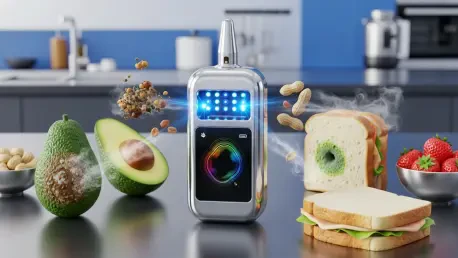

Every year, millions of consumers worldwide fall victim to foodborne illnesses or severe allergic reactions caused by invisible contaminants that escape standard human senses and traditional inspections. While traditional methods of determining food safety relied heavily on expiration dates or visual cues, the limitations of these indicators often resulted in either unnecessary waste or dangerous consumption. To address this critical gap in public health and supply chain management, researchers successfully engineered an advanced electronic nose capable of identifying molecular patterns associated with decay and allergen presence with unprecedented accuracy. This device operates by analyzing volatile organic compounds that emanate from food items, detecting the subtle chemical shifts that occur long before any physical signs of spoilage become apparent to the human eye. By bridging the gap between laboratory-grade mass spectrometry and portable consumer electronics, this technology represents a fundamental shift in how the world monitors the integrity of its food supply.
Advancements in Olfactory Sensor Technology: The Core Mechanism
The underlying mechanism of these electronic noses involves a complex array of gas sensors that mimic the biological functions of the mammalian olfactory system. These sensors typically utilize specialized materials such as metal-oxide semiconductors or carbon nanotubes that change their electrical resistance when exposed to specific gas molecules. Unlike a single-purpose chemical detector, the electronic nose employs a cross-reactive array where multiple sensors respond to a broad range of vapors. This collective response creates a unique chemical fingerprint for every scent, which is then processed to identify the exact state of the food product. Recent breakthroughs in nanotechnology allowed for the creation of sensors that are not only more sensitive but also more resilient to environmental factors like humidity and temperature fluctuations. This durability ensures that the device remains reliable in various settings, ranging from high-humidity industrial kitchens to the dry environments of refrigerated transport containers.
Integrating artificial intelligence into the olfactory hardware allowed the system to transition from a simple detection tool to a sophisticated diagnostic platform. Machine learning algorithms were trained on massive datasets containing the chemical profiles of thousands of food items at various stages of decomposition. By utilizing deep learning architectures, the system learned to differentiate between the natural ripening process and the onset of microbial spoilage, even when the differences were nearly imperceptible. This intelligence enables the device to provide a precise estimate of remaining shelf life rather than a binary assessment. Furthermore, the software can be updated remotely to recognize new pathogens or specific regional food varieties, ensuring that the technology remains relevant as global dietary habits continue to evolve. The synergy between high-fidelity hardware and adaptive software creates a robust defense against food waste, as retailers can now make informed decisions about inventory rotation based on real-time chemical data rather than arbitrary date stamps.
Precision Detection: Identifying Hidden Food Allergens
Beyond the detection of spoilage, the latest iteration of electronic nose technology demonstrated a remarkable ability to identify trace amounts of common allergens such as peanuts, shellfish, and gluten. This capability is particularly significant for individuals with life-threatening sensitivities, where even microscopic cross-contamination during food preparation can lead to anaphylaxis. The sensors are tuned to detect specific proteins and volatile markers that are unique to these allergenic substances. By sampling the air above a prepared dish or a production line, the electronic nose can alert staff to the presence of unintended ingredients before the product reaches the consumer. This level of detection was previously only possible in controlled laboratory settings using time-consuming techniques like enzyme-linked immunosorbent assays. Moving this power into a real-time, portable format offers a new layer of protection for the hospitality industry, allowing chefs to verify the safety of their offerings with a high degree of confidence and speed.
The implementation of these sensors in industrial food processing facilities significantly improved the speed and accuracy of quality control protocols. Traditionally, verifying the absence of allergens required taking physical samples and halting production while waiting for results, a process that was both costly and inefficient. The electronic nose allows for continuous, non-invasive monitoring of the production environment, identifying potential issues the moment they arise. If a specific allergen is detected in a line that is supposed to be free of it, the system can automatically trigger a shutdown or alert operators to investigate the source of the leak. This proactive approach not only protects consumers but also safeguards the reputation of food brands by preventing large-scale recalls that stem from labeling errors or cross-contact. As the technology continues to mature, its integration into standard manufacturing hardware will likely become a regulatory requirement, setting a new global benchmark for food safety and transparency.
Strategic Implementation: Looking Toward Industry Integration
The miniaturization of these electronic noses paved the way for their integration into everyday consumer devices, such as smartphones and smart home appliances. Manufacturers of high-end kitchen equipment began incorporating these sensors into refrigerators and pantries to monitor the freshness of stored goods automatically. When the system detected the early signs of milk souring or fruit decaying, it sent a notification to the user, suggesting immediate consumption or providing recipes to use the items before they expired. This level of household integration had the potential to significantly reduce the billions of tons of food wasted annually at the domestic level. In the professional sector, portable handheld scanners became a standard tool for health inspectors and restaurant managers, providing an objective metric for cleanliness and food quality that went beyond visual inspections. The data collected by these devices were also aggregated to track patterns in food safety outbreaks.
The adoption of electronic nose technology proved to be a transformative moment for the global food industry during its initial rollout. Stakeholders across the supply chain recognized that the ability to quantify freshness and safety provided a competitive advantage that justified the initial investment in new hardware. Moving forward, the focus shifted toward establishing international data standards to ensure that sensor readings remained consistent across different brands and regions. Industry leaders recommended that regulatory bodies develop a unified certification process for these devices to guarantee their reliability in critical safety applications. For consumers, the next logical step involved the widespread availability of low-cost, disposable sensors that could be integrated directly into food packaging, providing a real-time freshness meter. This evolution from centralized laboratory testing to decentralized, real-time sensing fundamentally changed the relationship between people and their food supply.