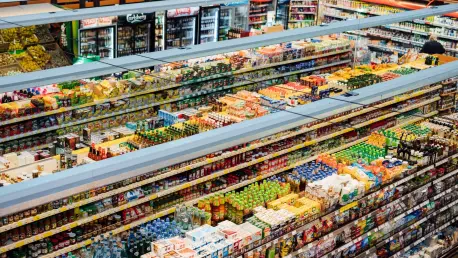

The British grocery landscape is navigating a complex period where fiscal expansion no longer equates to a corresponding increase in the actual quantity of goods moving through checkout lines. While total market value is projected to rise steadily through 2031, this trajectory is largely driven by price adjustments rather than an uptick in consumption or population demand. Analysts observe that households are becoming increasingly selective, prioritizing essential items while trimming the excess that once fueled volume-based growth. This shift represents a fundamental change in how retailers and manufacturers must measure success, moving away from simple turnover metrics toward more nuanced evaluations of value-added services and efficiency. As the industry recalibrates, the focus has moved toward maintaining margins in an environment where every percentage point of growth is hard-won through strategic pricing rather than sheer mass. Every segment of the supply chain is feeling the pressure to justify costs to a savvy consumer base that is more informed and budget-conscious than at any point in recent history.
Economic Drivers of Stagnant Volume
Sustaining Market Value: Pricing Dynamics
Current market dynamics indicate that the nominal growth seen across the UK food sector is effectively a reflection of heightened operational costs passed down to the end consumer. With energy prices and labor costs remaining at elevated plateaus since the start of 2026, the cost of production has prevented any significant deflation in food categories. Consequently, while the total expenditure on groceries is climbing, the actual tonnage of food purchased remains flat or even slightly negative in certain categories like premium meats and high-end dairy products.
This creates a paradox where financial reports show healthy revenue increases, yet warehouses and logistics networks see no real increase in the physical volume they handle daily. Retailers are finding that they must work twice as hard to maintain the same basket size as before, as shoppers have become masters of budget management. Consumers are opting for smaller packs or skipping non-essential treats entirely to stay within their strict financial limits, forcing brands to rethink their entry-level offerings and promotional strategies to capture dwindling attention.
Efficiency: The Shift in Consumer Diet
Beyond the immediate impact of shelf prices, the broader macroeconomic environment is influencing long-term consumer psychology regarding waste and necessity. Many households have adopted low-waste lifestyles, not just out of environmental concern, but as a direct response to the reality that wasting food is equivalent to wasting precious capital. This behavioral shift has led to a noticeable decline in the buy-one-get-one-free culture that once dominated British supermarkets, replaced instead by targeted discounts on single items and loyalty-driven rewards that prioritize precision over bulk purchasing.
Manufacturers are responding by resizing packaging to meet these smaller, more frequent shopping trips, which further decouples financial growth from volume growth. By 2031, the market is expected to look significantly more lean, with the gap between value and volume widening as premiumization in specific niches provides the only avenue for genuine profit expansion. The industry must now grapple with a reality where selling more is no longer the primary engine of prosperity, but rather selling better. Success is now defined by the ability to offer maximum nutritional value at a sustainable price point.
Industry Evolution and Strategic Shifts
Market Structure: Rise of Private Labels
The structural composition of the UK grocery market is undergoing a permanent transformation as discounters and private label offerings capture a larger share of the total spend. Big-name brands are finding it increasingly difficult to justify their price premiums when retailer-owned brands have achieved parity in quality while offering significantly better value for money. This trend has forced traditional supermarkets to reinvent their own-label tiers, often introducing entry-level luxury items that mimic the appeal of major brands at a fraction of the cost, appealing to the cost-conscious yet aspirational shopper.
As of 2026, the market share of private labels has hit record highs, and this dominance is expected to solidify further as we approach 2031. For manufacturers, this means the competitive landscape is no longer just about competing with other brands on the shelf, but about securing contracts to produce the very store-branded goods that are cannibalizing their traditional market share. This shift further suppresses volume growth for major labels while keeping the overall market valuation afloat through high-frequency transactions that prioritize consistent quality and reliability over brand loyalty.
Future Outlook: Strategic Resource Management
Stakeholders across the food supply chain realized that the traditional model of chasing volume was no longer sustainable in a market defined by high costs and cautious spending. It became clear that the path to success involved a total reimagining of value, where the quality of the experience and the ethics of production took precedence over the sheer quantity of goods sold. Companies that focused on transparency and sustainability found they could command the necessary price points to offset the lack of volume growth, effectively future-proofing their operations against further fluctuations.
This period saw a significant winnowing of the market, as those who failed to adapt to the new consumer reality were left behind by more agile competitors. The emphasis shifted toward localized sourcing and shortening supply chains, which reduced volatility and provided a stable foundation for modest financial gains. Innovation was no longer just about new flavors, but about creating efficient systems that minimized overhead while maximizing consumer convenience. By focusing on the intrinsic value provided to the customer rather than just units moved, the sector established a blueprint for operation in a resource-constrained world.