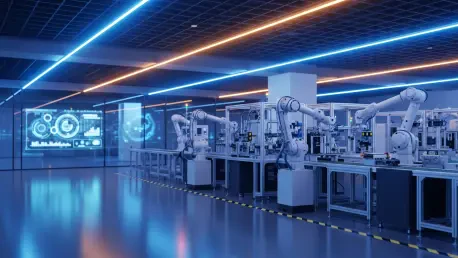

The rapid integration of sophisticated artificial intelligence systems within China’s industrial heartlands has effectively redefined the traditional boundaries of large-scale manufacturing output and efficiency across the globe. This transformation is not merely a localized trend but represents a fundamental shift toward a fully autonomous industrial model where data serves as the primary fuel for production decisions. Smart factories in hubs like Shenzhen and Suzhou are now utilizing advanced neural networks to synchronize complex assembly lines with global market fluctuations in real time. These facilities rely on a dense network of edge computing devices and high-speed connectivity to process terabytes of operational data every single hour. As a result, the transition from manual oversight to algorithmic governance has accelerated, allowing for a level of precision that was previously unattainable through human intervention alone. This evolution underscores a strategic commitment to maintaining a competitive edge in an increasingly automated world.
Integrating Artificial Intelligence into Production Lines
Predictive Maintenance: The Strategy of Zero Downtime
One of the primary drivers of this industrial leap is the implementation of predictive analytics which utilizes vast arrays of acoustic and thermal sensors to monitor machinery health with surgical precision. Instead of waiting for a component to fail, AI models detect microscopic anomalies in vibration patterns or temperature spikes that indicate wear before it becomes critical. This proactive stance ensures that maintenance is performed exactly when needed, rather than following a generic and often inefficient calendar-based schedule. By leveraging deep learning algorithms trained on billions of data points, manufacturers in the automotive and electronics sectors have successfully decreased unscheduled downtime by nearly forty percent. This technological layer acts as a safety net, allowing factories to run at peak capacity for longer durations without the constant threat of technical bottlenecks. The ability to forecast mechanical issues has effectively turned potential crises into manageable maintenance tasks, ensuring that the rhythm of production remains uninterrupted.
Machine Vision: Ensuring Flawless Quality Standards
Building on the foundation of mechanical reliability, advanced machine vision systems have replaced traditional inspection methods to ensure that every product meets rigorous quality standards. These systems utilize high-resolution cameras and proprietary image-recognition algorithms to scan items for micro-defects that are often invisible to the human eye. By analyzing surfaces at the micron level, the AI can instantly reject faulty components before they move further down the assembly line, significantly reducing waste and rework costs. This level of scrutiny is particularly vital in the semiconductor and medical device industries, where even the smallest deviation can lead to catastrophic failure. Furthermore, the data collected during these inspections is fed back into the production system to identify the root causes of recurring defects. This closed-loop communication allows for the continuous refinement of manufacturing processes, ensuring that the precision of the output improves with every batch produced, thereby solidifying the factory’s reputation for excellence.
Strategic Economic and Technical Implications
Digital Twins: Virtual Prototyping and Scalability
Strategic growth is further bolstered by the application of digital twin technology, which creates high-fidelity virtual replicas of entire production lines to simulate various operational scenarios before they are physically executed. This virtual sandbox allows engineers to stress-test new workflows, test different assembly configurations, and even predict the impact of new materials without pausing the actual machines. In the high-stakes world of aerospace fabrication, this capability has slashed the time required for research and development by half, enabling a rapid transition from design to market. By running millions of simulations in a cloud environment, companies can identify potential friction points and optimize the physical layout of the shop floor for maximum throughput. These digital counterparts are continuously updated with real-time feedback from the physical factory, ensuring that the virtual model remains a perfect reflection of reality. This loop allows for a level of iterative design that makes the manufacturing process as agile as modern software development.
Resilient Infrastructure: Enabling Real-Time Connectivity
The success of these smart factories depends heavily on a resilient infrastructure of 5G and 6G connectivity that supports the massive data throughput required for real-time synchronization. This high-speed communication network allows thousands of sensors and robotic arms to operate in perfect harmony, reducing latency to near-zero levels. When every machine is connected to a centralized intelligence, the factory can respond instantly to external supply chain disruptions or sudden shifts in consumer demand. This agility has become a cornerstone of modern industrial strategy, allowing firms to pivot their production focus within hours rather than weeks. Moreover, the integration of blockchain technology within these networks ensures that all data exchanges are secure and transparent, protecting sensitive intellectual property from cyber threats. By building a robust digital ecosystem, manufacturers have created a shield against market volatility. This interconnected approach ensures that the industrial sector remains a stable pillar of the broader economy while fostering a culture of perpetual innovation.
Strengthening Industrial Resilience through Technological Integration
To maintain this momentum, industrial leaders prioritized the development of standardized data protocols that allowed different AI platforms to communicate seamlessly across diverse manufacturing networks. They recognized that the true power of a smart factory lay not just in individual machines, but in the interconnectedness of the entire industrial ecosystem. Consequently, companies invested heavily in digital literacy programs to ensure that the workforce could effectively manage the sophisticated tools defining the current landscape. Engineers also optimized the use of edge computing to reduce latency, ensuring that critical decisions were made in milliseconds at the point of production. By implementing these strategic upgrades, manufacturers successfully navigated the complexities of global trade while setting a precedent for technological shifts. These actions provided a clear blueprint for regional hubs looking to revitalize their industrial bases through intelligent automation. Moving forward, the focus remained on the continuous refinement of cyber-physical systems to ensure long-term stability and growth.