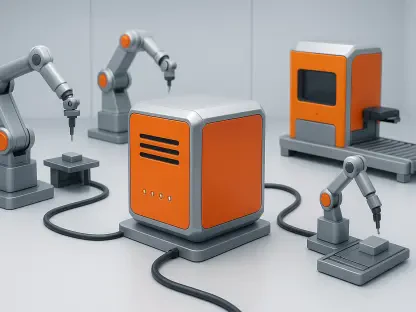

The traditional methodology of teaching sophisticated industrial hardware to perform complex tasks has long relied on labor-intensive manual coding or the collection of massive datasets through physical teleoperation. This approach created a significant bottleneck, as robots required thousands of hours of real-world interaction to master even simple pick-and-place maneuvers or fine motor assembly sequences. However, the emergence of the FLUX-mimic framework has fundamentally shifted this paradigm by utilizing high-fidelity generative video models to synthesize training data that is virtually indistinguishable from reality. By leveraging the latent knowledge embedded within large-scale vision-language models, researchers can now simulate intricate robotic movements and environmental interactions without the need for a physical robot during the initial learning phases. This technological leap addresses the reality gap, allowing autonomous systems to visualize success before they ever touch a physical component.
Synthesizing Realistic Motion for Autonomous Systems
The core innovation of this system lies in its ability to generate photorealistic video sequences that depict a robot successfully completing a task from diverse camera angles and under varying lighting conditions. Traditional simulators often struggle with the sim-to-real transition because they lack the visual complexity and physical nuances of a real-world manufacturing environment. In contrast, FLUX-mimic uses a diffusion-based architecture to dream up millions of possible scenarios, incorporating subtle physics interactions such as friction, occlusion, and object deformation that were previously impossible to model accurately in standard software. Because the generative model is trained on vast amounts of human and robotic video data, it understands the fundamental laws of motion and causality. This allows the system to produce training videos that serve as a gold standard for imitation learning, where a robot’s control policy is optimized by watching these synthetic demos.
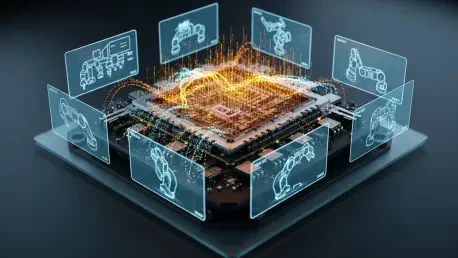
Beyond mere visual reproduction, the framework incorporates a specialized mapping layer that translates the pixels of a generated video into actionable motor commands for specific industrial hardware. This process involves a deep alignment between the visual representations of the task and the proprioceptive feedback of the robotic arm, ensuring that what the model sees is physically achievable by the machine. This alignment is critical for maintaining safety and accuracy in high-stakes environments like semiconductor fabrication or aerospace assembly. By training on generative video, the robot effectively practices in a hallucinated reality that encompasses a far wider range of edge cases than could ever be staged in a laboratory setting. If a component is slightly misaligned, the generative model can provide immediate visual feedback on how to correct the error, thereby building a level of robustness that was once exclusive to human operators, transforming machines into agents.
Strategic Implementation: The Next Era of Robotics
As these generative models continue to evolve, the focus is shifting toward zero-shot generalization, where a robot can perform a task it has never physically attempted based purely on a single video prompt. The FLUX-mimic architecture lays the groundwork for this by creating a universal visual language for task completion that is not tied to a specific hardware configuration. This means that a policy trained on generative video for a six-axis arm could, with minimal fine-tuning, be adapted for a humanoid robot or a mobile manipulator. This level of flexibility is essential for the future of logistics and warehouse automation, where environments are dynamic and the variety of objects to be handled is nearly infinite. By decoupling the task description from the physical execution through an intermediary generative video layer, the industry is moving toward a world where programming a robot is as simple as showing it a video of what needs to be done, regardless of the underlying physics.
To fully realize these benefits, organizations adopted a proactive stance toward integrating generative AI into their existing automation pipelines. The successful deployment of FLUX-mimic demonstrated that the convergence of vision models and robotics was no longer a theoretical exercise but a practical necessity for maintaining a competitive edge. Industry leaders prioritized the creation of high-quality proprietary video datasets to further refine these models, ensuring that the synthetic output remained grounded in the specific realities of their production environments. Moving forward, the emphasis shifted toward establishing standardized benchmarks for generative training to ensure interoperability between different robotic platforms and software providers. Engineers and data scientists collaborated to refine the latent spaces of these models, making them more responsive to real-time sensor feedback and unpredictable human interaction, successfully navigating a path to autonomy.