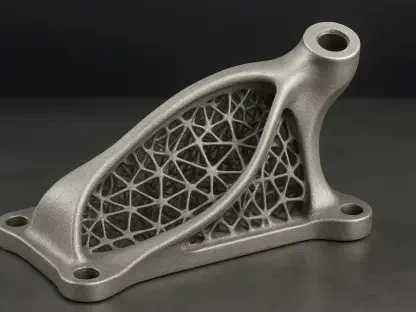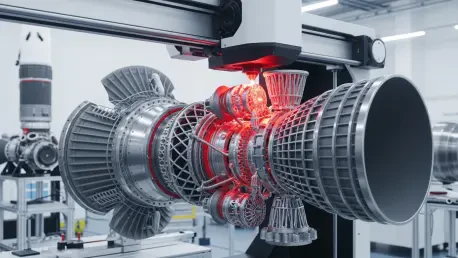

The sound of a rocket engine firing on a test stand represents years of iterative labor, but the traditional ways of forging these complex machines are rapidly disappearing in favor of digital algorithms and high-powered lasers. The aerospace industry currently stands at a crossroads where additive manufacturing is no longer a peripheral technology used for non-critical brackets, but rather the very foundation of modern propulsion systems. Companies such as Munich-based Electro Optical Systems have led this charge, proving that the move toward 3D printing is fundamentally a move toward industrial reliability and scalability. By moving away from subtractive methods that waste immense amounts of high-grade alloys, engineers are embracing a digital workflow that allows for the creation of monolithic structures that were previously impossible to manufacture. This shift enables a streamlined production model where complex assemblies, which once required hundreds of separate components and joints, are now consolidated into single, high-performance parts.
The Evolution: Artificial Intelligence and Computational Modeling
A major breakthrough in this field is the definitive move away from standard Computer-Aided Design toward purely computational modeling. Through collaborations with AI specialists like LEAP71, the industry has successfully developed functional rocket engines without direct human intervention in the design phase. This data-driven approach removes human emotional attachments to legacy templates, allowing AI to generate optimized engine specifications in a matter of weeks rather than the months typically required by traditional engineering teams. These algorithms can process millions of variables simultaneously, finding the ideal balance between thermal management, structural integrity, and weight. Instead of drawing lines and circles, engineers now define the physical constraints and performance goals, letting the software grow the part organically. This transition ensures that the final geometry is perfectly suited for its specific mission profile, bypassing the limitations of human intuition.
These AI-designed thrusters have already proven their worth in rigorous hot-fire testing, performing exactly as predicted by their digital models without the need for multiple expensive prototypes. The precision of computational design ensures that fluid dynamics within the combustion chamber are optimized to a level that was previously unattainable. When an algorithm manages the cooling channels and injector patterns, the resulting engine operates at higher efficiencies and temperatures. This level of performance validation provides a high degree of confidence for mission planners, as the digital twin of the engine precisely matches the physical hardware. This synergy between software and hardware means that errors are caught in the virtual environment long before a single gram of metal powder is fused. As these technologies mature, the gap between conceptual design and flight-ready hardware continues to shrink, allowing for a more aggressive and successful development pace in the competitive space sector.
Global Scalability: Automation and Decentralized Manufacturing
In the competitive landscape of the modern space race, the speed of iteration is the primary driver of innovation. Additive manufacturing allows for prototyping cycles that are measured in weeks, enabling designers to test and refine components almost instantly after a data set is finalized. Furthermore, this technology offers unique scalability that traditional factories simply cannot match; instead of massive re-tooling or building new casting facilities, companies can expand their production capacity simply by adding more modular printing units. Because these digital blueprints can be shared instantly across the globe, manufacturing can be decentralized to reduce logistics hurdles and create a more flexible supply chain. A design perfected in a European lab can be printed at a launch site in the United States or a facility in Australia on the same day. This mobility of production ensures that the aerospace industry is no longer tethered to a few specific geographic hubs.
To maximize operational efficiency, the industry is increasingly focusing on the full automation of the entire production cycle. In the past, 3D printing required significant manual labor to reset machines and remove finished parts, leading to costly downtime during overnight shifts and weekends. By automating these roles with robotic handling systems, manufacturers have reduced transition times between prints to roughly an hour, ensuring that high-powered lasers remain productive around the clock. This relentless focus on maximizing laser uptime significantly lowers the overall cost per part, making space exploration more economically viable for a wider range of commercial and scientific interests. From 2026 to 2028, the integration of autonomous post-processing will likely become the standard, further removing human error from the equation. High-volume production of rocket engines is now a matter of managing data and powder logistics rather than managing a traditional assembly line.
Industry Sustainability: Standards and Workforce Readiness
Meeting the stringent safety and quality regulations of the aerospace sector requires extreme precision, often at the micrometer scale, which 3D printing is uniquely equipped to provide. Industry leaders are actively working with global regulatory bodies to standardize additively manufactured components, ensuring they meet the same rigorous qualifications as forged parts. The ultimate goal is to achieve a level of manufacturing maturity where parts meet all safety requirements on the very first print, eliminating the need for expensive and time-consuming post-processing or secondary machining. This level of precision not only ensures flight safety but also allows for the integration of complex internal features, such as integrated sensors and advanced cooling paths, that bolster the overall reliability of the spacecraft. By establishing these universal standards, the industry creates a stable foundation for the next decade of orbital infrastructure and deep-space exploration.
The long-term economic sustainability of space travel relied heavily on the durability and reusability of these printed parts. Some components demonstrated a level of resilience that drastically reduced the cost of putting payloads into orbit after surviving more than 30 separate launches. However, fully realizing this potential required a significant shift in the human element of engineering. The industry focused on retraining professionals to think through the lens of additive manufacturing, bridging the educational gap between traditional physics and algorithmic design. Leaders ensured that the next generation of engineers mastered these creative tools, moving beyond legacy constraints to explore new geometries. This proactive approach to workforce development solidified the transition to a fully digital aerospace ecosystem. By prioritizing both technical excellence and educational reform, the sector successfully moved toward a future where rapid space access became an everyday reality.