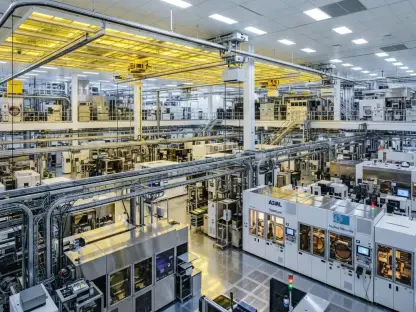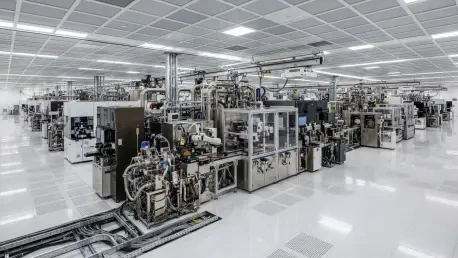

The integration of AI-driven engineering allows semiconductor companies to protect their profit margins while accelerating production timelines for next-generation hardware. This shift is critical as the industry approaches the 2-nanometer threshold, where atomic-scale physics introduces unpredictable behaviors that traditional lithography struggled to control. In 2026, the reliance on high-NA EUV lithography has made the fabrication process so sensitive that even the slightest temperature fluctuation or chemical impurity can lead to a total loss of yield. To counter these risks, manufacturers have turned to artificial intelligence to manage the staggering number of variables involved in modern chip production. By digitizing the physical environment of the fab, these companies are moving away from the expensive “build and break” cycles of the past. This evolution represents a fundamental reconfiguration of how human ingenuity and machine processing power interact to push the boundaries of silicon.
Navigating the Complexity of Advanced Nodes
The Engineering Crisis: Predictive Modeling as a Solution
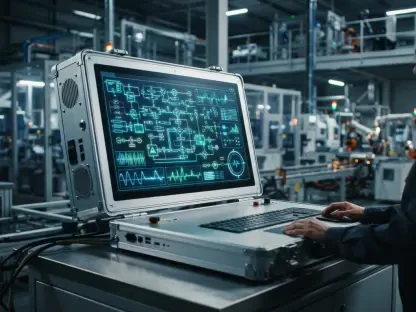
The current engineering crisis in the semiconductor sector stems from the fact that human-led analysis can no longer keep pace with the exponential growth of design rules. In a modern fabrication plant, the sequence of operations involves hundreds of steps, including deposition, etching, and cleaning, all happening at a scale where a single nanometer makes the difference between a high-performance processor and expensive scrap. Historically, verifying a new process required the creation of physical test wafers, a labor-intensive method that often took several weeks to produce results. Today, machine learning models have enabled “in silico” testing, where entire manufacturing sequences are simulated within a virtual environment. These simulations account for fluid dynamics, chemical reactions, and thermal stress with high fidelity, allowing engineers to identify potential failure points before any physical equipment is activated. This proactive approach significantly lowers the capital expenditure required for research.
Surgical Precision: Automated Defect Tracing and Yield
The speed at which AI systems can identify the root causes of production errors has redefined operational efficiency. When a batch of wafers fails to meet specifications, the historical response involved a painstaking manual investigation of every machine on the floor, a process that could halt production for days. Modern AI algorithms instead utilize massive datasets harvested from thousands of sensors throughout the fab to map defects back to their specific origin almost instantly. Whether the issue is a microscopic misalignment in a lithography lens or a subtle chemical imbalance in a vapor deposition chamber, the AI provides actionable insights that allow for immediate correction. By maintaining higher yields through this surgical precision, semiconductor companies can ensure that their most advanced product lines remain profitable even during the volatile early stages of a new node ramp-up. This level of granular control is now a standard requirement for any fab aiming to compete in the global market.
Strategic Cycles and the Human Element
The Nvidia Flywheel: Real-Time Optimization and Metrology
A symbiotic relationship has developed between hardware manufacturers and the software driving their production lines, often called the “Nvidia Flywheel.” This concept describes a self-reinforcing cycle where advanced graphics processing units used to train deep learning models are the same tools utilized by fabrication plants to optimize workflows. As these fabs become more efficient through AI-driven insights, they gain the capacity to produce even more complex chips, which are used to develop the next generation of artificial intelligence. This cycle effectively addresses the global bottleneck of compute production by ensuring that as demand for hardware escalates, the technology to build that hardware evolves at a proportional rate. For a manufacturer, successfully entering this cycle provides a competitive advantage, as it allows for the rapid scaling of production while reducing the cost per transistor. This trend is central to maintaining the pace of innovation as physical limits become harder to overcome.
Protection of Assets: Addressing the Trusted Intelligence Gap
While the transition to an AI-centric manufacturing model offers benefits, it introduces risks regarding data security and intellectual property. The machine learning models used to optimize a fab are trained on proprietary datasets that represent decades of specialized knowledge. Consequently, these models have become high-value assets that must be shielded from cyber threats and internal data leaks. Protecting these digital assets requires a robust infrastructure that can handle sensitive information without compromising the speed of the AI’s learning process. Moreover, a “trust gap” exists between experienced process engineers and the algorithmic recommendations generated by the AI. Bridging this gap requires transparent AI systems that can explain the logic behind a suggested process adjustment. Without this level of interpretability, engineers may be hesitant to gamble a multi-million-dollar production run on a “black box” prediction, regardless of how accurate the model has been in previous simulations.
Forging a Resilient Future: Strategic Insights and Next Steps
The transition toward AI-integrated fabrication proved that the industry could no longer rely on manual iteration to solve the challenges of sub-3nm geometries. By prioritizing the development of robust digital twins and predictive modeling, manufacturers successfully navigated the extreme volatility of the high-NA EUV era. These organizations recognized that data was just as vital as the chemical precursors used in their cleanrooms, leading to a more secure and automated manufacturing environment. For stakeholders looking to maintain a competitive edge, the path forward required an immediate investment in secure AI infrastructure and a commitment to upskilling the existing workforce. The successful companies were those that treated AI not as a peripheral tool but as a central nervous system for their entire operational stack. As physical limits continued to tighten, the industry discovered that the combination of machine precision and human strategic oversight was the only way to sustain the global compute economy.