
The global electronics assembly sector is currently undergoing a profound metamorphosis as facilities pivot away from the brittle structures of legacy automation toward dynamic, vision-guided systems that thrive on variability. For decades, the industry relied on “blind” robots programmed to move to exact coordinates with sub-millimeter precision, yet these machines often proved surprisingly fragile when confronted with the slight imperfections of a real-world factory floor. This traditional model, while effective for massive batches of identical products, falters when parts arrive slightly misaligned or when a production line requires a quick changeover to a new SKU. In the current landscape of 2026, the demand for agility has rendered the old ways obsolete, forcing a shift toward machines that can perceive their surroundings and make autonomous adjustments. By integrating advanced 3D sensors and sophisticated neural networks, manufacturers are finally bridging the gap between theoretical engineering and the messy reality of the shop floor, ensuring that automation serves as a flexible asset rather than a rigid liability. This transition represents a shift in fundamental manufacturing philosophy, moving from a world where humans must accommodate the limitations of machines to one where machines are intelligent enough to navigate the inconsistencies inherent in physical production.
The Financial Realities: Moving Beyond Rigid Systems
Manufacturers frequently encounter the deceptive lure of what is often termed “spreadsheet efficiency,” a phenomenon where the theoretical output of a robotic cell looks perfect on paper but fails to account for the operational friction of daily use. In many instances, the assumption that a single robotic arm can seamlessly replace a manual operator ignores the high cost of the technical oversight required to keep that arm functioning in a static environment. When a robot lacks the ability to sense minor deviations, such as a circuit board being seated just a fraction of a millimeter off-center, the entire line often grinds to a halt. Instead of reducing labor costs, these rigid installations frequently swap a medium-wage assembly worker for a high-salary automation engineer who must spend hours recalibrating sensors or clearing mechanical jams. This hidden overhead transforms what was intended to be a cost-saving measure into a significant financial drain, particularly when the system lacks the onboard intelligence to troubleshoot its own environment. Consequently, the true value of automation is increasingly measured not by how fast a robot can move in a vacuum, but by how long it can operate autonomously without requiring human intervention to correct minor physical discrepancies.
This lack of adaptability creates an even more pronounced crisis within High-Mix, Low-Volume (HMLV) manufacturing environments, which represent a significant portion of the contemporary industrial landscape. In these settings, production runs are shorter, and the variety of components is vast, meaning that a robot must be reprogrammed or mechanically retooled with frustrating frequency. If the time required to set up a robotic workstation for a new product batch exceeds the time it would take for a human to complete the task manually, the automation investment becomes fundamentally counterproductive. Conventional systems struggle with supply chain variability, where a change in a secondary supplier might result in components with slightly different reflective properties or packaging configurations that confuse “blind” optical sensors. Without the capacity to intelligently interpret these changes, the factory floor becomes a bottleneck of logistical hurdles rather than a streamlined engine of production. To survive in an economy that demands rapid customization and overnight delivery, manufacturers must move beyond the “set it and forget it” mentality of the past and embrace systems that can learn and adapt to new tasks with minimal downtime or specialized coding.
The Sensory Evolution: Integrating Intelligence and Perception
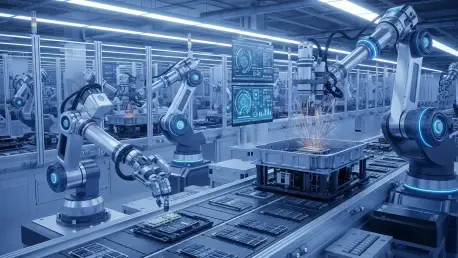
The solution to these rigid limitations lies in the widespread adoption of intelligent perception, a technology suite that combines high-resolution 3D vision with edge-based artificial intelligence to give robots a functional sense of sight. Unlike traditional systems that rely on fixed coordinate systems, these perception-enabled machines can identify parts tossed randomly into a bin or placed at odd angles on a conveyor belt. By analyzing a three-dimensional point cloud of their workspace in real time, these robots can calculate the optimal trajectory for a pick-and-place operation, accounting for obstacles and potential collisions without any pre-programmed instructions for that specific layout. This level of autonomy eliminates the need for expensive and inflexible custom jigging, which was previously required to ensure every part was held in an exact, predictable location. As a result, the factory floor becomes a much more fluid environment where the robot acts as an intelligent agent capable of interpreting its surroundings and making split-second decisions to ensure task completion despite environmental noise or mechanical drift.
Beyond mere movement, intelligence is being deeply woven into the assembly process through the integration of real-time, in-situ quality control mechanisms. Vision-equipped robotic grippers can now perform high-speed inspections of components, such as checking for bent connector pins or surface defects, while the part is being moved from a tray to a printed circuit board. This convergence of assembly and inspection represents a major leap forward in operational efficiency, as it allows for the immediate rejection of faulty components before they are ever permanently soldered or fastened. In the past, quality issues were often only discovered at the end of a long production line during functional testing, leading to expensive rework or the scrapping of nearly finished products. By utilizing neural networks to recognize “good” versus “bad” parts on the fly, manufacturers can maintain a zero-defect mandate without slowing down the cadence of the assembly line. This proactive approach to quality not only reduces waste but also provides a wealth of data that can be analyzed to identify upstream supply chain issues or subtle wear and tear in the robotic hardware itself before a failure occurs.
Operational Resilience: Finding the Right Automation Balance
Industry experts are increasingly advocating for a more pragmatic “80% objective” in automation, moving away from the pursuit of 100% “lights-out” manufacturing which often results in over-engineered and fragile ecosystems. The logic behind this shift is grounded in the recognition that the final twenty percent of assembly tasks often involve complex tactile feedback or subjective judgments that are prohibitively difficult and expensive to automate reliably. By focusing robotic resources on the bulk of tasks that are standardized and repetitive, factories can maximize their return on investment while maintaining a high degree of resilience. This hybrid model allows human workers to focus on the exceptions—handling fragile ribbon cables, performing final aesthetic checks, or troubleshooting unforeseen mechanical anomalies—while the robots handle the heavy lifting and high-speed precision work. This strategic division of labor ensures that the production line remains moving even when a unique challenge arises that would otherwise paralyze a fully automated system. It creates a flexible partnership where the machine provides consistency and the human provides the cognitive flexibility needed to navigate the unexpected.
The concept of modularity further supports this balanced approach by transforming robots from permanent, floor-bolted fixtures into mobile and versatile factory resources. In a modern facility, a robotic cell is often designed as a self-contained unit that can be unplugged and wheeled to a different part of the plant as production demands shift throughout the fiscal year. This mobility allows manufacturers to scale their automation efforts dynamically, reassigning a “screwdriving” robot to an “inspection” station if a particular product line experiences a sudden surge in volume or a change in design. Such flexibility is a vital hedge against the volatility of the global market, where consumer preferences can shift in a matter of weeks, rendering fixed assembly lines obsolete. When robots are treated as modular assets rather than static infrastructure, the capital expenditure risk is significantly reduced, as the hardware remains productive across multiple generations of products. This evolution toward a “plug-and-play” robotic architecture ensures that small and medium-sized enterprises can compete with larger entities by building a fleet of versatile machines that grow alongside their specific business needs.
Security and Competition: The Role of Edge Computing
As artificial intelligence becomes a central nervous system for robotic operations, the industry is seeing a decisive move toward local edge computing to safeguard sensitive intellectual property and process data. Many manufacturers remain wary of streaming high-resolution video of their proprietary assembly techniques or circuit designs to external cloud servers due to the inherent risks of data breaches or latency issues. By utilizing high-performance local servers situated directly on the factory floor, companies can run complex machine learning models and process visual data in milliseconds without ever letting that information leave their secure internal network. This “edge-first” strategy provides the dual benefit of extreme speed and robust security, allowing robots to learn from their mistakes and update their operational parameters in real time. It also ensures that the factory can continue to operate at full capacity even if external internet connectivity is compromised, a critical consideration for mission-critical electronics manufacturing. The ability to refine AI models locally means that a factory can develop a unique competitive advantage, as its robots become more efficient based on the specific nuances of that particular facility’s workflow.
This transition toward adaptive, perception-based systems is no longer a luxury but a fundamental necessity for maintaining economic resilience in regions with high labor costs. By embracing the reality of imperfection and focusing on real-time decision-making, manufacturers can offset the high wages of a domestic workforce without sacrificing the agility required for complex, low-volume orders. In the past, the only way to compete with low-cost labor markets was through massive scale and extreme standardization, but intelligent robotics has rewritten that script. Modern factories can now produce highly customized, sophisticated electronics with the same efficiency as a mass-production facility, all while maintaining a smaller, more specialized footprint. This strategic hybridization of human insight and machine precision ensures that the local manufacturing base remains globally competitive, capable of responding to supply chain disruptions and shifting trade policies with localized, high-tech production. The successful integration of these technologies marks the end of the era of “dumb” automation and the beginning of a period where the factory floor is an intelligent, evolving organism that grows more capable with every part it assembles.
The Strategic Shift: Implementing Next-Generation Automation
The shift toward intelligent systems required a fundamental reassessment of how precision was valued on the modern production floor. Leaders in the field recognized that the “precision paradox”—where systems failed because they were too rigid for an imperfect world—necessitated a move toward sensory-driven flexibility. Facilities that successfully adopted these technologies prioritized modularity and human-robot collaboration, which allowed them to pivot quickly during market fluctuations. They invested in edge computing to ensure data sovereignty while reaping the benefits of machine learning to optimize cycle times. This transition ultimately proved that the most resilient factories were those that did not strive for a perfect environment, but rather built the intelligence to navigate an imperfect one. By focusing on the integration of 3D vision and adaptive AI, these organizations secured their place in a competitive landscape where speed and adaptability became the primary drivers of long-term operational success and economic growth.
Success in the electronics manufacturing landscape ultimately depended on an organization’s commitment to treating automation as a continuous evolution rather than a static procurement. This necessitated the establishment of internal technical teams who bridged the gap between artificial intelligence development and mechanical engineering, ensuring that robotic learning models remained current with shifting production data. Instead of viewing human labor and robotic systems as opposing forces, the most resilient enterprises treated them as symbiotic partners where machine consistency supported human cognitive flexibility. These companies successfully identified the specific eighty percent of their workflows best suited for intelligent automation while intentionally preserving space for human intervention in complex edge cases. By adopting this balanced posture, they constructed a production environment that was not only faster but significantly more robust against global supply chain volatility. This strategic path was defined by a commitment to sensory intelligence and human oversight, creating a manufacturing ecosystem that remained as resilient as it was innovative during a period of intense technological disruption.