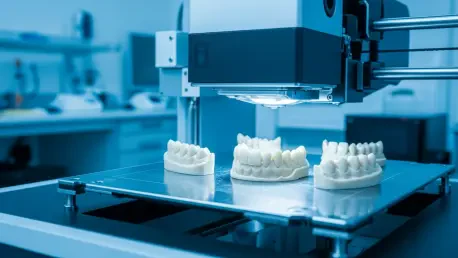

The dental industry has reached a critical turning point where the traditional craftsmanship of hand-layered ceramics is rapidly being replaced by the high-speed precision of automated additive manufacturing. For a restoration to succeed in a clinical environment, it must provide a near-perfect seal against the natural tooth structure, as even microscopic gaps can harbor harmful bacteria and lead to secondary decay or periodontal failure. Researchers at The Fourth Military Medical University have recently conducted a groundbreaking analysis to refine the use of Digital Light Processing technology in the creation of resin-based crowns. By systematically examining how various software settings influence the physical outcome of printed restorations, this study provides a comprehensive roadmap for dental technicians seeking to eliminate the trial-and-error approach that often plagues digital workflows. This advancement ensures that the final prosthetic not only looks natural but also maintains its structural integrity over several years of use.
Analyzing the Impact: Print Angle and Layer Thickness
The investigation specifically scrutinized how two fundamental variables—the orientation of the print and the thickness of each individual layer—interact to dictate the ultimate quality of resin-based ceramic crowns. These materials are becoming a standard in modern restorative work because they offer a unique combination of aesthetic translucency and a modulus of elasticity that closely mimics human dentin. However, the process of photo-polymerization, where liquid resin is cured by light, inherently introduces risks of dimensional instability as the material transitions from a liquid to a solid state. To address this, the research team utilized a digital scan of a mandibular molar and produced hundreds of test samples across a spectrum of angles ranging from 90 to 270 degrees. This exhaustive testing allowed the scientists to visualize how gravitational forces and light diffraction patterns during the printing process contributed to subtle warping or inaccuracies in the final product.
Finding the optimal balance between manufacturing speed and clinical accuracy led the researchers to identify a specific range of settings that yielded the highest level of trueness. The data demonstrated that crowns oriented at moderate angles, specifically between 150 and 180 degrees, exhibited the least amount of deviation from the original computer-aided design model. When these specific angles were paired with a layer thickness of 50 micrometers, the internal fit—which is the space between the crown and the tooth—was optimized to a degree that significantly outperformed thicker layer settings. This high-resolution approach ensures that the intricate geometry of the tooth preparation is captured, allowing the crown to seat fully without rocking or leaving exposed margins. By adhering to these standardized parameters, laboratories can consistently produce restorations that meet the rigorous demands of modern prosthodontics while minimizing the need for manual corrections.
Structural Integrity: Balancing Accuracy and Repeatability
While the finer 50-micrometer setting proved superior for capturing the most minute anatomical details, the study also highlighted a critical trade-off involving the consistency of the manufacturing process. Crowns printed using a 100-micrometer layer thickness showed a more concentrated and predictable distribution of errors, suggesting that thicker layers might offer better repeatability across large batches. This is a vital consideration for commercial dental laboratories that manage high volumes of work, where the predictability of the output is just as important as absolute precision. However, for individual, complex cases where the marginal fit is the paramount concern, the thinner layer remains the gold standard. The choice between these settings depends largely on the specific priorities of the dental technician and the clinical requirements of the patient, illustrating that there is no one-size-fits-all solution in digital manufacturing but rather a range of optimized choices.
A particularly insightful portion of the research focused on spatial deviations, which describe how different regions of a single crown might deform in different directions during the printing cycle. The team observed a consistent pattern where the marginal areas—the thin edges that meet the gum line—tended to experience inward shrinkage due to the cumulative stresses of the resin hardening. Conversely, the occlusal or biting surfaces often displayed a slight outward bulging, a phenomenon attributed to the fluid dynamics of the resin as it is displaced by the build platform. This understanding of “warping patterns” is revolutionary because it allows technicians to apply digital compensation strategies. By intentionally adjusting the digital file to account for these known physical behaviors, the industry can move toward a “zero-adjustment” workflow where the printed crown fits the patient perfectly the moment it is removed from the printer and post-processed.
Clinical Efficiency: Enhancing Workflow and Patient Care
The immediate practical application of this research lies in its ability to significantly streamline the chairside experience for both dentists and their patients. By implementing the recommended 150 to 180-degree print angles, clinicians can drastically reduce the time spent grinding and polishing a crown to achieve a functional fit during the delivery appointment. When a restoration is manufactured with high dimensional fidelity, it seats faster and requires fewer occlusal adjustments, which preserves the structural integrity of the ceramic material and ensures the patient’s bite remains comfortable. This reduction in chairside time not only increases the profitability and efficiency of the dental practice but also reduces the physical strain on the patient. This evolution toward predictable digital manufacturing means that the days of repetitive fitting and manual reshaping are quickly becoming a relic of the past, replaced by a much more reliable and data-driven process.
Building on these findings, the dental community is now better equipped to understand the complex relationship between light-cured materials and the hardware used to process them. This study has paved the way for the development of smarter slicing software that can automatically suggest the best orientation based on the specific geometry of a restoration. Furthermore, the insights gained into how resin behaves under different curing conditions will likely influence the next generation of 3D printing resins, which may be designed with lower shrinkage rates or enhanced stability. As the industry continues to move toward more personalized care, the ability to fine-tune every aspect of the manufacturing process ensures that patients receive restorations that are not only beautiful but are also engineered for long-term health. The mastery of these subtle printing parameters represents a significant leap forward in the quest for the perfect dental prosthetic.
Future Outlook: Implementation and Quality Standards
The research concluded that the precise calibration of printing parameters was the most effective way to bridge the gap between digital theory and clinical reality. By establishing that a moderate print angle and a fine layer thickness were essential for crown trueness, the study provided a clear set of actionable guidelines for practitioners to adopt immediately. It was determined that these settings significantly minimized the volumetric discrepancies that typically lead to poor marginal adaptation and subsequent restoration failure. The findings also emphasized that while hardware capabilities have advanced rapidly, the human element of selecting the correct software configurations remained the deciding factor in the success of the printed crown. This shift toward evidence-based settings ensured that the technological transition in dentistry was supported by rigorous scientific data rather than anecdotal evidence or manufacturer presets that might not have been optimized for specific clinical dental applications.
Moving forward, the integration of these validated printing protocols into daily laboratory routines facilitated a higher standard of care across the restorative landscape. The study encouraged a collaborative approach where technicians and clinicians utilized these data points to refine their internal quality control measures, ensuring that every restoration met a baseline of dimensional accuracy. As these optimized settings became standard, they served as a foundation for further innovations in multi-material printing and adaptive curing techniques. The industry successfully transitioned to a model where the physics of the printing process were respected and utilized to enhance the longevity of dental work. Ultimately, the systematic application of these research findings allowed the dental field to achieve a level of consistency and reliability that was previously unattainable, securing a future where digital restorations consistently outperformed their traditional counterparts in both fit and function.