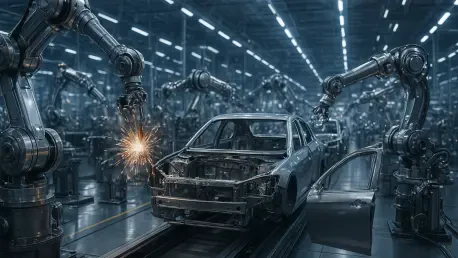

Precision testing and automation firms are seeing increased market value as they qualify the specialized chips and sensors required for mission-critical robotic systems. This shift marks a pivotal moment where speculative interest in robotics has finally crystallized into a concrete, finance-driven industrial roadmap. At the center of this transformation is a significant upward revision in market projections, suggesting a massive capital expenditure super-cycle that will redefine global labor and technology interactions. Current forecasts indicate that annual shipments of humanoid robots could reach 6.5 million units by 2035. This trajectory begins with an entry point of 75,000 units in 2026, scaling rapidly to nearly 900,000 units by 2030. Rather than focusing on consumer applications, the immediate demand stems from industrial sectors like logistics and automotive manufacturing, where machines can automate repetitive and physically taxing labor tasks on the production line.
The Humanoid Industry Stack: Analyzing the Compute and Foundry Layers
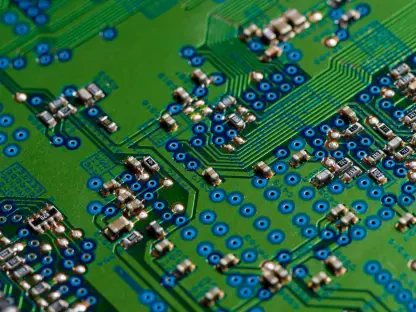
To comprehend how this market functions, one must examine the multi-layered “humanoid stack” and the dominant corporations steering its development. At the foundational compute layer, NVIDIA provides the essential AI frameworks and high-performance hardware required for real-time decision-making. These systems, including platforms like Omniverse and Isaac, are currently being integrated into massive warehouse operations to manage vast robotic fleets. Directly above this sits the critical foundry layer, where Taiwan Semiconductor Manufacturing Company serves as the primary manufacturer of high-end silicon. As humanoid robots evolve, they require increasingly sophisticated on-board processing power to handle complex spatial awareness and motor control. This reliance on advanced semiconductor nodes ensures that the demand for specialized chips will remain a primary driver of the industry’s growth through 2030, creating a feedback loop between hardware and robotic utility in the industrial world.
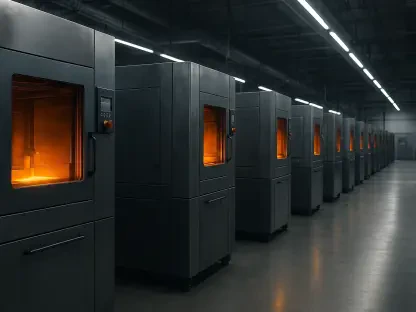
Beyond the production of silicon, the industry relies heavily on a specialized test and automation layer to ensure the precision and long-term reliability of robotic sensors and limbs. Companies like Teradyne play an indispensable role here, qualifying mission-critical hardware before it ever reaches the factory floor or the end-user. At the top of the industrial hierarchy are the original equipment manufacturers, such as Tesla with its Optimus project, which aim to mass-produce humanoid units at an unprecedented scale. These companies are currently repurposing assembly lines to accommodate the specialized manufacturing requirements of robotic joints and actuators. Supporting this entire ecosystem is a financier layer composed of major institutions that provide the vast capital needed to build global infrastructure. This transition represents one of the most significant industrial migrations in history, fueled by a synergy between high-end engineering and a global appetite for labor-saving systems.
Market Divergence: Balancing Supply Chain Stability and OEM Volatility
Despite the overall bullish outlook, market reactions have revealed a clear divergence between various sectors of the robotics economy. Currently, the most consistent financial gains are being captured by “pick-and-shovel” providers—the firms producing the underlying chips, sensors, and testing equipment. These entities benefit from the broad infrastructure build-out regardless of which specific robot model eventually dominates the market. In contrast, the companies manufacturing finished humanoid robots often encounter higher volatility and downward pressure as they navigate the immense complexities of large-scale production and real-world deployment. The challenge for these manufacturers lies in bridging the gap between a successful prototype and a reliable, cost-effective industrial tool. Investors are increasingly favoring the stability of the component supply chain while remaining cautious about the long-term profitability of the robots themselves until clear return-on-investment metrics are widely established.
Looking for a blueprint for future success, many analysts point to specialized fields like robotic surgery as a vital proof of concept. Systems used in high-precision medical environments have already achieved global scale, demonstrating that robotics can thrive in highly regulated and mission-critical settings. This “commercialization analog” provides a realistic view of how the broader humanoid market might mature as it moves into the next decade. Success in surgical robotics was not achieved overnight but through decades of refinement in safety, reliability, and human-machine collaboration. As humanoid robots enter the logistics and manufacturing sectors, they will likely follow a similar path of incremental adoption followed by rapid expansion once the technology proves its worth in varied environments. The transition from 2026 to 2035 will involve moving from these specialized applications to generalized labor, a process that requires both technical breakthroughs and a fundamental shift in corporate capital.
Strategic Integration: Navigating Ethical Governance and Future Growth
The ambitious path toward shipping 6.5 million robots is not without significant societal and ethical hurdles. Concerns regarding the safety and governance of advanced AI have become a central topic of discussion among high-ranking officials and engineers at leading research firms. Some experts have voiced existential concerns, suggesting that the risks associated with highly capable autonomous systems require more stringent oversight than currently exists. This has led to calls for a “voluntary pause” or a deliberate slowdown in deployment to ensure that safety protocols and regulatory frameworks can keep pace with rapid technological progress. If regulatory bodies or major corporations decide to implement such measures, it could act as a significant brake on the capital expenditure cycle that is currently driving market valuations. The tension between the desire for industrial efficiency and the need for ethical safeguards remains a primary risk factor that could delay the timeline for widespread humanoid adoption.
Historically, the robotics industry was characterized by isolated innovations, but the current era consolidated these efforts into a unified industrial movement. The transition through 2030 proved that hardware and software synergy could unlock unprecedented productivity, while the initial journey toward 2035 necessitated more than just technical prowess. Organizations prioritized the development of clear safety standards and interoperability protocols to avoid fragmented ecosystems that hindered growth. The focus shifted from merely building robots to integrating them into a “Physical AI” infrastructure that complemented human labor rather than seeking a total replacement. Strategic investment in training programs to manage these robotic fleets became as essential as the capital spent on the machines themselves. By fostering a collaborative environment between technologists and regulators, the industry ensured that the projected market growth translated into sustainable value for the global economy.