
The rapid evolution of renewable technology has pushed the physical dimensions of wind turbines beyond the capabilities of standard industrial machinery, creating a critical need for unprecedented lifting solutions. As offshore wind farms move further into deeper waters, the components required to capture high-altitude winds have grown exponentially in weight and length. Traditional crane designs often struggle with the sheer height required to install these massive nacelles and blades, which can now reach altitudes exceeding 250 meters. This architectural gigantism is not merely a matter of prestige but a fundamental requirement for meeting global decarbonization targets. Without machinery capable of maneuvering six-thousand-ton loads at great heights, the transition to green energy could stall due to logistical bottlenecks. The arrival of ultra-heavy lift cranes represents a pivotal shift, allowing engineers to rethink the entire lifecycle of turbine deployment from fabrication to final installation.
Operational Excellence: Scaling Infrastructure for the Renewable Transition
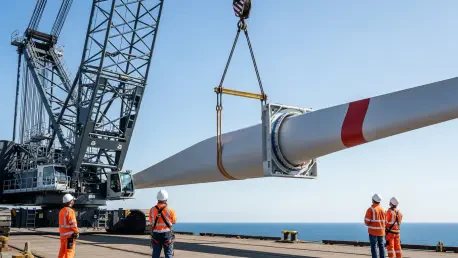
The Mammoet SK6000 crane stands as a testament to modern engineering, offering a lifting capacity that effectively doubles the industry standard for land-based operations. This massive apparatus was designed specifically to handle the components of 20-megawatt turbines, which feature blades longer than a soccer field and nacelles that weigh as much as several large aircraft. By utilizing a containerized design, the crane can be transported and assembled at coastal sites without the need for extensive foundation reinforcements that typically plague such heavy equipment. This versatility ensures that existing ports can serve as staging grounds for the next generation of offshore projects. Furthermore, the crane’s unique ability to lift heavy loads while maintaining a small footprint allows for more efficient use of limited quay space. This technical leap forward ensures that developers are no longer restricted by mechanical limitations, enabling the construction of taller power plants that maximize energy capture.
Modular construction techniques have become significantly more viable through the application of such extreme lifting capabilities, drastically reducing the time required for onsite assembly. Instead of piecing together small sections in hazardous environments, crews can now pre-assemble massive structural modules in controlled settings before the crane performs a single, decisive lift. This approach minimizes the number of critical operations performed at height, which inherently increases safety for the specialized labor force involved. Moreover, the reduction in assembly cycles translates directly to lower capital expenditures for developers, making renewable energy projects more competitive against traditional fossil fuel sources. The efficiency gains are particularly noticeable in the offshore sector, where weather windows are narrow and every hour of delay costs thousands. By streamlining these processes, these heavy-lift systems are essentially de-risking the financial landscape of large-scale green energy investments.
The strategic deployment of high-capacity lifting assets was recognized as a turning point in global energy infrastructure development. To sustain this momentum, stakeholders prioritized the modernization of coastal docking facilities, ensuring they could withstand the immense ground pressure of super-heavy cranes. Furthermore, the integration of real-time sensor data during the lifting process became a standard safety protocol, reducing the margin of error in volatile maritime conditions. Investment in specialized vocational training also ensured that a new generation of engineers was equipped to handle the unique complexities of 20-megawatt turbine installations. By treating heavy lift technology as a core component of early-stage project design rather than a late-stage logistical requirement, the industry successfully lowered its overall risk profile. These coordinated efforts transformed the renewable sector into a highly efficient industrial machine, providing a clear and actionable blueprint for the continued expansion of carbon-neutral power networks.