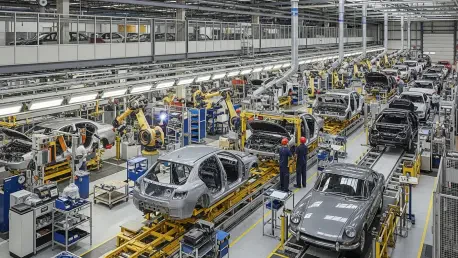

The British automotive industry stands at a critical juncture where the decisions made by the current government regarding electric vehicle adoption will determine the survival of domestic manufacturing. This sector has long served as a pillar of the national economy, supporting hundreds of thousands of skilled jobs and generating billions in export revenue. However, the lack of a cohesive industrial strategy has left many manufacturers feeling exposed to shifting global tides. Central to the current debate is the Zero Emission Vehicle mandate, which dictates the percentage of new cars that must be battery-powered as the nation progresses from 2026 to 2030. Critics argue that any hesitation in enforcing these standards will not only confuse consumers but also signal to global investors that the United Kingdom is no longer a serious contender in the race for clean transport. Maintaining a firm stance is essential for securing the long-term viability of high-tech production sites across the country.
The Foundation of Industrial Strategy
The Zero Emission Vehicle mandate functions as the bedrock of the United Kingdom’s industrial policy by providing a predictable and transparent roadmap for the shift to electric powertrains. By establishing clear targets, the government offers the necessary signals to automotive giants and their complex web of suppliers, allowing them to allocate capital with a degree of certainty. This regulatory framework was never intended solely as an environmental measure; it was designed as a tool for economic revitalization. When manufacturers have a clear view of the future regulatory landscape, they are more likely to commit to long-term projects such as domestic assembly lines and parts sourcing. Without such a mandate, the risk of investment flight becomes a tangible reality, as companies seek environments where policy objectives are consistent and well-defended. The current period from 2026 to 2028 represents a vital window for proving that the nation can maintain its regulatory integrity.
Softening the existing regulations would likely destroy the investment case for the United Kingdom, prompting massive capital-intensive projects to relocate to regions with more stable and ambitious frameworks. Major players in the automotive sector have already warned that a U-turn on emissions targets would undermine the business models of proposed battery gigafactories, which are essential for a localized supply chain. These facilities require immense upfront costs and decades of operation to reach profitability, making them highly sensitive to political instability. If the government chooses to dilute its commitments, it risks turning the country into an industrial backwater that merely imports technology rather than creating it. The knock-on effects would be devastating for regional economies that rely on these manufacturing hubs for high-wage employment. To avoid this outcome, the administration must prioritize the stability of its industrial incentives to ensure that the UK remains an attractive destination.
Global Competition and Policy Paralysis
While the United Kingdom grapples with internal policy debates, its primary economic competitors are moving forward with aggressive and well-funded industrial support programs. China has already solidified its position as a global leader in the electric vehicle market by combining massive state subsidies with strict production targets and control over essential raw materials. Similarly, the European Union is utilizing its own industrial acts to encourage local manufacturing and implement protective measures against low-cost imports that could undercut domestic producers. In contrast, the UK currently appears to be in a state of policy paralysis, struggling to define its role in a world that is rapidly moving away from fossil fuels. By hesitating on its regulatory commitments, the country risks falling behind nations that have successfully paired environmental legislation with active financial protection. The competitive gap is widening, and the window for catching up with these global superpowers is closing.
Beyond the immediate regulatory challenges, the British automotive industry faces deep-seated structural hurdles that complicate its transition to a cleaner future. High industrial energy costs remain a significant barrier to competitive manufacturing, making it difficult for local plants to match the production efficiency of their international rivals. Furthermore, the market is currently facing a significant influx of foreign brands, particularly from East Asia, which are outperforming established British-based manufacturers in both the electric and hybrid segments. This influx suggests that the UK cannot simply hide from the global transition by slowing its own adoption rates, as foreign competitors are already winning market share across all vehicle categories. The presence of these brands on British roads serves as a constant reminder that the industry must modernize or face obsolescence. Addressing these high overhead costs requires a multifaceted approach that combines energy reform with targeted support.
Strategic Actions for Industrial Resilience
The government recognized that a successful transition required more than just setting targets; it necessitated a comprehensive ecosystem that supported every stage of the manufacturing process. Officials focused on securing the supply of critical minerals by establishing new trade partnerships with resource-rich nations, ensuring that domestic battery producers had a stable stream of raw materials. They also prioritized the modernization of the national grid to accommodate the massive increase in electricity demand that accompanied the widespread adoption of electric vehicles. By investing in regional innovation clusters, the state helped bridge the gap between academic research and commercial application, allowing British start-ups to scale their technologies more effectively. These actions demonstrated a clear commitment to industrial growth, showing that the nation was prepared to compete on a global stage by leveraging its unique strengths in engineering and high-end manufacturing.
To further strengthen the industrial base, policymakers implemented targeted financial incentives that encouraged the repurposing of existing facilities for new powertrain technologies. This approach allowed long-standing manufacturing hubs to pivot toward electric vehicle production without displacing the existing workforce or abandoning established infrastructure. The administration also streamlined the planning process for new industrial sites, significantly reducing the lead time for constructing state-of-the-art factories and research centers. By fostering a collaborative environment between the public and private sectors, the government ensured that the benefits of the transition were felt across the entire country, from the industrial heartlands to the southern technology corridors. These strategic moves solidified the United Kingdom’s reputation as a reliable partner for global automotive firms, providing the long-term stability needed to anchor production for decades.