
The traditional boundary between a product’s conceptual design and its physical realization is undergoing a profound transformation as industrial standards struggle to keep pace with the rapid proliferation of advanced fabrication techniques. While Design for Manufacturability (DFM) has long served as the fundamental framework for ensuring that parts can be produced efficiently and cost-effectively, the modern landscape has introduced layers of complexity that were unimaginable just a decade ago. Engineering firms are now finding that the old rules of thumb, which prioritized extreme simplification and material reduction, are being challenged by the advent of high-fidelity additive systems and a new generation of designers who have been educated in a digital-first environment. This shift is not merely a change in tooling but a fundamental reimagining of how geometric possibilities are weighed against the constraints of the factory floor. As companies navigate these changes, they must reconcile the historical focus on subtractive efficiency with the modern demand for functional performance, all while managing a workforce that is increasingly comfortable with software-driven design but sometimes disconnected from the gritty realities of chip-making and material stresses. The integration of DFM into university curricula and the rapid rise of additive manufacturing have created a new set of expectations and challenges that today’s professionals must navigate to remain competitive.
Bridging Academic Theory and Workplace Reality
Historically, the formalization of design principles that prioritize manufacturing ease gained significant traction during the industrial shifts of the mid-20th century, specifically throughout the 1950s and 1960s. During this era, researchers and academic institutions began to develop rigorous mathematical models to quantify the time and cost associated with manual and automated assembly. These early frameworks established the foundational logic that reducing part counts and simplifying fastener strategies would directly translate to improved profitability. The academic world successfully translated these industrial observations into standardized textbooks, creating a curriculum that emphasized structural integrity alongside production speed. By documenting the physics of metal removal and the economics of scale, these early educators provided a robust theoretical scaffolding that still supports modern engineering education. However, the legacy of this era was a focus on rigid constraints, which taught designers to think primarily in terms of what a standard three-axis mill or a high-speed stamping press could achieve, often prioritizing ease of production over the sheer performance potential of the final component. This approach served the industry well for decades, cementing the idea that the designer’s primary job was to work within the narrow confines of established factory capabilities.
Despite the strength of this academic foundation, a persistent friction point has emerged between the theoretical knowledge imparted in university classrooms and the day-to-day requirements of a modern production facility. Fresh engineering graduates often enter the workforce with a deep understanding of the reasons behind manufacturing efficiency but lack a nuanced grasp of practical execution when confronted with real-world limitations. This gap exists because manufacturing technology, especially in the 2026 landscape, evolves at a rate that traditional academic cycles struggle to match, often leaving degree programs teaching techniques that are several iterations behind the state-of-the-art. While a student might understand the theoretical shear strength of a material, they may not have been taught how a specific tool’s vibration or thermal expansion can ruin a precision part on a busy Tuesday afternoon. This disconnect creates a steep learning curve where the new professional must adapt to a world where machine availability, operator skill levels, and material batch inconsistencies dictate the final design’s success. Bridging this vacuum requires a more integrated approach where academic theory is continuously tempered by hands-on experience and direct exposure to the evolving hardware found in commercial machine shops.
Navigating the Paradox of Additive Manufacturing
The democratization of additive manufacturing has introduced a fascinating paradox where the sudden removal of traditional geometric constraints has made the task of design more complex rather than simpler. Nearly every major engineering program now features advanced 3D printing labs, allowing students to iterate on designs in hours rather than weeks, which fosters a high degree of creativity and experimentation. This environment encourages a sense of design freedom that is incredibly powerful for prototyping, as it allows for the creation of organic shapes and internal features that would be impossible to machine. However, this freedom often acts as a double-edged sword because it can lead designers to overlook the fundamental economic realities of high-volume production. When a designer becomes accustomed to a machine that can produce nearly any shape without traditional tooling, they may lose sight of the fact that additive processes are often significantly slower and more expensive per unit than injection molding or casting for large production runs. This leads to a situation where a technically brilliant prototype is developed that is entirely unviable for the mass market, forcing a costly and time-consuming redesign phase that could have been avoided if the designer had remained grounded in traditional manufacturing logic.
Navigating this paradox requires a sophisticated understanding of how to balance the innovative potential of additive manufacturing with the precision and speed of traditional subtractive methods. CNC machining and turning remain the gold standard for achieving the tight dimensional tolerances and superior surface finishes required for critical mechanical interfaces, such as bearing seats or sealing surfaces. Modern engineers must learn to view additive manufacturing not as a total replacement for the lathe and the mill, but as a complementary tool that excels in specific niches like lightweighting and part consolidation. For example, a component might be designed with a 3D-printed core to reduce weight while still requiring precision-machined exterior dimensions to ensure a proper fit within a larger assembly. This hybrid mindset demands that the contemporary designer understands the specific capabilities and limitations of various materials, such as how different metal powders react during the sintering process compared to how a solid billet behaves under a cutting tool. Mastery of modern DFM involves knowing exactly when to utilize the flexibility of additive processes and when the reliable, high-speed output of a traditional subtractive process is the more responsible and profitable choice for the project at hand.
Purposeful Complexity and the Shift-Left Strategy
Unlike the classic DFM strategies of the past, which almost universally focused on simplifying designs to lower costs, the current era of additive technology promotes a concept known as purposeful complexity. In high-performance sectors such as aerospace and medical device manufacturing, the goal is no longer to make a part as simple as possible, but to leverage complex geometries to add significant functional value. This shift has led to the creation of intricate lattice structures, non-linear cooling channels, and topology-optimized shapes that mimic biological forms. These features allow for unprecedented strength-to-weight ratios and thermal management capabilities that were previously unattainable with conventional tooling. The challenge for the modern engineer is to move away from the habit of asking how to simplify a design for the sake of the machine and instead focus on how complexity can be strategically deployed to improve the product’s performance. This requires a fundamental change in the design mindset, where the engineer must be able to justify the added complexity by demonstrating clear improvements in energy efficiency, longevity, or overall system performance that outweigh the higher initial production costs associated with advanced additive fabrication.
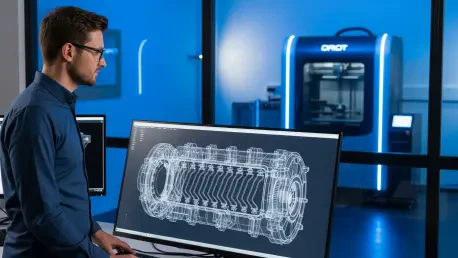
To manage the risks associated with this increased design complexity, the manufacturing industry is increasingly turning to a shift-left strategy that utilizes advanced simulation software at the very beginning of the development cycle. By integrating digital twins and physics-based modeling early in the process, engineers can visualize the entire additive deposition or subtractive cutting sequence before a single gram of material is ever utilized on the shop floor. These sophisticated digital tools allow teams to identify potential issues such as thermal warping, structural weak points, or tool collisions long before the design reaches the quoting or production stage. This proactive approach helps prevent the phenomenon of the blueprint blow-up, where a project is delayed because a design that looked perfect in a CAD environment is found to be unmanufacturable or prone to failure in the physical world. Furthermore, early simulation allows for a more accurate estimation of production costs and lead times, providing stakeholders with the data they need to make informed decisions about whether a complex additive approach is truly justified. As simulation software becomes more accessible and integrated into standard design workflows, the ability to predict and mitigate manufacturing hurdles in a virtual space is becoming a standard requirement for any successful engineering team.
Managing Human Connection and the Experience Vacuum
One of the most significant and often overlooked hurdles in modern manufacturing is the persistent communication gap that exists between design engineers and the staff working on the production floor. Despite the proliferation of digital communication tools, successful DFM remains a deeply human challenge that requires designers to step out of their isolated digital environments and engage directly with the machinists and technicians who will actually build the parts. A digital model can often mask practical difficulties, such as a lack of clearance for a specific cutting tool or the awkward orientation required to fix a part on a machine bed. When designers fail to consult with production experts early in the process, they run the risk of creating designs that are technically feasible but practically a nightmare to execute, leading to increased labor costs and high scrap rates. Building a culture of interdisciplinary collaboration ensures that the specialized knowledge of the machinist—who understands the nuances of material behavior and machine quirks—is integrated into the design from the start. This human connection is essential for refining designs to be not only manufacturable but also repeatable and profitable, ensuring that the final physical product accurately reflects the designer’s original intent without unnecessary manufacturing friction.
The industry addressed the experience vacuum created by the retirement of seasoned manufacturing experts by prioritizing the formalization of intuitive knowledge into digital protocols and shared databases. Organizations found that by pairing junior designers with veteran machinists in collaborative workshops, they successfully transferred critical hands-on insights that were previously missing from academic curricula. These companies also implemented standardized DFM software that provided real-time feedback during the design process, which allowed for the immediate identification of geometric features that would cause production delays. Management teams recognized that investing in cross-training programs helped engineers understand the physical limitations of the shop floor, while also giving production staff a better grasp of the design intent behind complex additive parts. By fostering a more integrated relationship between the digital design phase and the physical manufacturing environment, firms ensured that their most innovative concepts were grounded in reality. These proactive measures ultimately transformed the design-to-production workflow, turning potential manufacturing bottlenecks into competitive advantages that allowed for faster time-to-market and higher overall product quality. Moving forward, the focus remained on maintaining this synergy between advanced digital tools and human expertise to navigate the evolving technological landscape.