
The shift from passive manufacturing to active “AI factories” represents the most significant industrial pivot since the invention of the assembly line. By integrating intelligence into the production flow itself, companies are transforming facilities into massive supercomputers that design their own successors.
This evolution is driven by the realization that hardware for high-stakes computing requires a manufacturing environment as sophisticated as the chips themselves. The modern industrial revolution is no longer about raw output but about the intelligent orchestration of data and physical resources.
The Paradigm Shift Toward AI-Centric Semiconductor Fabrication
The era of disconnected manufacturing silos has ended, replaced by a holistic ecosystem where design and production exist in a constant feedback loop. This transition toward “physical AI” implies that the facility is no longer just a shell for machinery but a responsive entity capable of self-optimization in real-time.
By treating the factory as a software-defined asset, manufacturers achieve a level of precision that human oversight alone could never replicate. This shift allows for the rapid iteration of complex hardware, ensuring that production keeps pace with the blistering speed of algorithmic development.
Foundational Components: Building the Intelligence
The core of the AI factory rests on a tripod of advanced simulation, virtualization, and specialized hardware integration. These elements work in concert to eliminate the trial-and-error approach that previously hampered semiconductor lead times.
AI-Driven Simulation and Engineering Workflows
Modern fabrication relies on specialized frameworks like PhysicsNeMo to predict how new materials behave at the atomic level. This shift enables engineers to simulate chip performance before a single wafer is processed, drastically reducing time-to-market.
Utilizing internal workflows allows leaders to leverage previous breakthroughs to solve new design challenges. This compounding cycle of innovation ensures that the engineering process is as automated as the physical assembly line.
Fab Digital Twins and Virtualized Environments
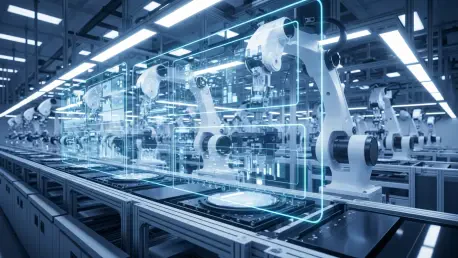
The use of 3D virtual environments through OpenUSD pipelines allows for high-fidelity digital twins that mirror every physical movement on the floor. These virtual spaces serve as risk-free sandboxes where logistics are optimized before physical hardware is installed.
This methodology minimizes downtime and ensures that the complex dance of robotics remains synchronized. It provides a level of operational visibility that was previously impossible in traditional fab environments.
High-Performance Memory Integration for Advanced Computing
Advanced memory solutions have become the literal bottleneck of progress, necessitating the deep integration of high-bandwidth memory into next-generation CPUs. The technical requirements for platforms like the Vera Rubin supercomputer demand extreme thermal efficiency and data throughput.
Consequently, memory is no longer a peripheral component but a core architectural pillar. This technical necessity drives the collaboration between chip designers and memory manufacturers to create unified, high-performance systems.
Emerging Trends: Automation and Optimization
Decision optimization engines are now managing everything from energy consumption to robotic paths with millisecond precision. This trend reflects a massive surge in capital expenditure as firms race to build the infrastructure required for global hardware demand.
The convergence of digital training and physical manufacturing ensures that lessons learned in simulation are instantly applied to the assembly line. This creates a truly autonomous loop where the factory learns to be more efficient with every hour of operation.
Diverse Applications: Robotics and Cloud Infrastructure
The AI factory model extends beyond the cleanroom, influencing how entire nations approach digital sovereignty. From robotic logistics to gigawatt-scale clouds, the impact of this technology is felt across the entire industrial spectrum.
Robotics and Autonomous Mobile Logistics
Robotic platforms are now the primary movers within the fab, navigating complex environments with zero human intervention. By applying physical AI frameworks, these robots perceive surroundings with enough granularity to operate safely alongside delicate equipment.
This autonomy reduces the risk of contamination and human error, which are the most frequent causes of production delays. It transforms material handling from a manual chore into a streamlined, data-driven process.
National-Scale AI Infrastructure and Cloud Integration
The evolution of telecommunications into national AI infrastructure marks a fundamental change in digital security. Gigawatt-scale AI clouds are becoming the backbone of industrial strength, providing the power needed for enterprise-scale support.
Strategic partnerships bridge the gap between regional energy resources and the global demand for computing. These initiatives ensure that the benefits of AI manufacturing are distributed across broader economic sectors.
Technical Hurdles: Obstacles to Market Adoption
The financial barrier to entry for gigawatt-scale facilities remains astronomical, often requiring state-level backing to be viable. Furthermore, the technical challenge of maintaining real-time synchronization between a digital twin and a physical factory is immense.
Regulatory and logistical complexities also complicate the rollout of these high-tech hubs across diverse geographic zones. Addressing these hurdles requires a level of international cooperation that the industry has yet to fully realize.
Future Outlook: The Path to Intelligent Manufacturing
Long-term supply chain resilience will depend on the ability of autonomous factories to pivot production without significant retooling. Breakthroughs in chip-making might eventually allow for real-time architectural adjustments during the fabrication process itself.
The next decade will see a redistribution of industrial power toward those who master the intersection of software and heavy manufacturing. This evolution will fundamentally alter the global competitive landscape for decades to come.
Summary Assessment: The Industrial Verdict
The integration of AI into the semiconductor lifecycle proved to be more than an efficiency upgrade; it redefined the limits of manufacturing. Industry leaders demonstrated that the only way to build powerful AI was to let AI assist in the building process.
While the capital requirements were daunting, the resulting increase in production speed established a new standard for global industry. Ultimately, the AI factory model provided a scalable solution to the hardware shortage, ensuring the infrastructure of the future remained robust.