
High-performance manufacturing environments across the globe are currently witnessing a seismic shift as traditional production methods struggle to keep pace with the relentless demands of the green energy revolution and the rapid expansion of electric vehicle fleets. In this high-stakes landscape, Blue Ocean Robotics has emerged as a critical catalyst for change, specifically targeting the intricate logistics within solar panel, lithium-ion battery, and automotive production facilities. By deploying sophisticated Autonomous Mobile Robots and Automated Guided Vehicles, the company is effectively bridging the gap between raw material influx and finished product output. This transition represents far more than a simple equipment upgrade; it signifies a fundamental shift toward intelligent, data-driven ecosystems where automation is no longer a luxury but a necessity for survival. As global markets pivot toward sustainable technologies, the ability to move materials with surgical precision and unwavering consistency has become the defining characteristic of modern industrial success.
Solving the Logistics Crisis in Modern Factories
Identifying Key Bottlenecks: Technological Gaps in Production
The rapid scaling of electric vehicle battery production has exposed significant vulnerabilities within internal factory logistics that were previously overlooked during smaller-scale operations. Human-led material handling is increasingly recognized as a primary bottleneck because it remains inherently susceptible to fatigue, error, and physical limitations that cannot match the high-speed, continuous cycles of today’s assembly lines. These manual processes often result in uneven throughput, where the pace of production is dictated not by the capacity of the machinery but by the speed at which components can be moved from one station to the next. Such inefficiencies create a widening disparity between theoretical output and actual delivery, preventing facilities from reaching their full economic potential. Without a cohesive strategy to automate the movement of heavy, sensitive materials, manufacturers find themselves trapped in a cycle of reactive problem-solving that drains resources and slows down the time-to-market.
Overcoming Integration Barriers: Legacy System Inefficiency
Beyond the clear limitations of human labor, many factories continue to grapple with legacy automated systems that frequently fail to perform in increasingly complex and dynamic industrial environments. These older iterations of automated guided vehicles often lack the intelligence to navigate around unexpected obstacles or communicate effectively with other robotic units, leading to localized traffic jams that paralyze entire sections of the floor. These operational stalls are compounded by the presence of data silos, where different stages of the manufacturing process operate in isolation without sharing real-time logistical information. This lack of synchronization makes it nearly impossible for traditional plants to transition into true smart factories, as the various components of the production line remain disconnected. Consequently, the industry has reached a tipping point where the demand for more sophisticated, interoperable robotic solutions has become urgent to ensure that the entire manufacturing chain functions as a unified, agile entity.
Leading the Market Through Proprietary Innovation
Full-Stack Ecosystems: Controlling Hardware and Software
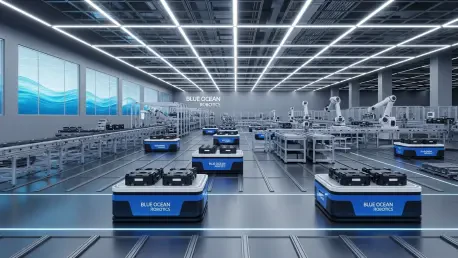
To overcome these persistent systemic challenges, Blue Ocean Robotics developed a comprehensive full-stack technological ecosystem that grants them total control over every aspect of their robotic hardware and software. This proprietary approach involves designing everything from the mechanical chassis and sensors to the complex motion algorithms and firmware that dictate how each robot interacts with its environment. At the heart of this system is a sophisticated scheduling software capable of orchestrating the movements of massive fleets containing up to 512 individual robots across thousands of distinct loading points. Such a high level of coordination is vital for massive industrial plants that require extreme precision and the flexibility to navigate varying floor conditions without human intervention. By integrating these disparate elements into a single, cohesive platform, the firm ensures that each robotic unit operates with maximum efficiency, reducing downtime and optimizing the flow of materials through every phase of the assembly process.
Financial Trajectory: Growth and Market Standing
The profound impact of this technical strategy is clearly reflected in the company’s exceptional financial trajectory and its rising prominence within the global industrial sector. Since the beginning of the current decade, the firm has maintained an impressive average annual growth rate of 300%, a feat that has secured its position on the prestigious future unicorn lists in several major manufacturing hubs. This explosive expansion is driven by a relentless focus on research and development, which has allowed the company to stay ahead of competitors by securing numerous patents and industry awards. By establishing a dominant presence in the most concentrated manufacturing regions, the organization has proven that its solutions are not only scalable but also essential for high-volume production. This market success is a direct result of identifying untapped opportunities where advanced logistics can provide immediate, transformative value to industrial operations, turning logistical costs into a competitive advantage for their clients.
Strategic Vision and Future Projections
Targeted Investment: Scaling Navigation and Global Support
Looking at the current landscape, Blue Ocean Robotics is strategically utilizing its recent rounds of investment to significantly upgrade its core navigation algorithms and explore new industrial applications. These focused financial resources are being funneled into making robots even more capable of handling unpredictable and crowded environments, ensuring that they can function safely alongside human workers without losing operational speed. Furthermore, the company is prioritizing the expansion of its global sales and support networks, providing a localized infrastructure that can handle the unique needs of diverse markets. By continuing to refine the interaction between artificial intelligence and physical machinery, the firm is pushing the boundaries of what autonomous systems can achieve in specialized sectors beyond traditional automotive manufacturing. These advancements are aimed at further boosting logistical efficiency by approximately 60%, while simultaneously reducing labor costs and enhancing the overall safety profile of large-scale industrial plants.
Strategic Implementation: Enhancing Global Production Standards
The implementation of these advanced logistics solutions established a new operational standard that prioritized data-driven precision over manual intervention. Manufacturers who successfully integrated full-stack robotic ecosystems realized immediate gains in throughput and significantly mitigated the risks associated with internal supply chain disruptions. Moving forward, the industry turned its attention toward the cross-platform integration of robotics with broader enterprise resource planning systems to create a seamless flow of information. To maintain a competitive edge, decision-makers focused on investing in flexible automation platforms that could adapt to changing product designs and shifting market demands without requiring a complete overhaul of factory infrastructure. This transition necessitated a shift in workforce training, as technical staff moved into roles centered on the management and maintenance of intelligent fleets. By embracing these innovative strategies, the industrial sector solidified its ability to meet global sustainability targets while ensuring long-term profitability and resilience.