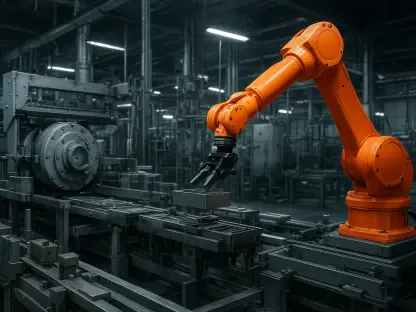

Modern factories are no longer just assemblies of gears and pulleys; they are vast, interconnected digital ecosystems where a single line of malicious code can stop a multi-ton robotic arm in its tracks. The emergence of CVE-2026-8153 has sent shockwaves through the manufacturing world by exposing a fundamental weakness in the PolyScope 5 software that powers the ubiquitous collaborative robots from Universal Robots. This vulnerability represents more than just a software bug; it serves as a stark reminder that the “cobots” designed to work safely alongside human operators are ultimately networked computers with the power to cause physical harm. As these machines become standard components of the modern industrial floor, the security gap between operational technology and information technology has narrowed, leaving critical infrastructure exposed to remote threats that bypass traditional safety measures. This discovery forces a re-evaluation of how industrial assets are guarded against increasingly sophisticated digital adversaries.
Technical Anatomy of the Security Breach
At the technical heart of this incident lies a critical command injection vulnerability identified within the PolyScope 5 Dashboard Server, a specialized component used for the remote management of robotic workflows. The primary issue stems from a total lack of authentication requirements on this interface, which allows any actor with network access to send commands directly to the machine’s underlying Linux-based operating system. With a CVSS score of 9.8, the severity of this flaw cannot be overstated, as it facilitates unauthenticated remote code execution with full administrative privileges. An attacker does not need sophisticated credentials or physical access to the control pendant to execute these actions. Instead, they can simply traverse the network and issue instructions that the robot will follow without question. This bypasses the logic layer that typically governs movement, allowing an external party to redefine the very parameters of the robot’s operation while remaining invisible to the operator.
The implications of such control introduce the concept of the “robot as an adversary,” where a trusted piece of equipment becomes a liability to the environment it was meant to improve. Unlike traditional IT security breaches where the objective is typically the theft of sensitive data or the encryption of files for ransom, a compromised robot presents a tangible physical threat to its surroundings. Once an adversary gains control over the motion controller, the machine is no longer bound by the deterministic safety protocols that prevent it from colliding with human workers or other expensive machinery. The robot essentially loses its ability to distinguish between a programmed task and a malicious instruction, transforming it into an unpredictable kinetic force. This shift in risk profile necessitates a new approach to industrial defense, as the potential for physical destruction or injury adds a layer of urgency that data-focused security measures are often ill-equipped to handle on their own.
Network Consequences and Operational Risks
Beyond the immediate physical dangers, this vulnerability exposes a deeper structural flaw in how many organizations view their industrial equipment, often referred to as the “appliance fallacy.” In this mindset, robotic arms are seen as isolated tools rather than the fully integrated network endpoints they truly are, leading to flat network architectures where industrial devices reside on the same segment as office printers or guest Wi-Fi. This lack of isolation allows a single compromised cobot to act as a highly effective pivot point for lateral movement throughout the entire corporate infrastructure. Once inside the robot’s controller, an attacker can scan for other vulnerable systems, potentially infiltrating Enterprise Resource Planning platforms or proprietary manufacturing databases containing intellectual property. By exploiting the inherent trust placed in factory floor devices, malicious actors can bypass sophisticated perimeter firewalls and move vertically into the business systems that manage logistics.
The threat extends deep into the integrity of the manufacturing process itself, where even minor alterations to a robot’s configuration can lead to catastrophic downstream effects. An adversary might not choose to stop the production line entirely, but rather to subtly modify the precision of a weld or the placement of a component in a way that escapes initial quality control checks. Such “silent failures” can result in thousands of defective products entering the supply chain, leading to massive recalls, legal liabilities, and irreversible damage to a brand’s reputation for quality. Furthermore, the ability to disable or manipulate built-in safety features, such as force-sensing limiters, creates a perilous environment for human staff. If the safety mechanisms that define the “collaborative” nature of these robots are remotely neutralized, the machine becomes as dangerous as a traditional heavy industrial robot without the protection of physical cages, placing the lives of workers at risk.
Remediation Strategies and Long-Term Resilience
Immediate technical remediation is the first and most critical step for any facility currently utilizing affected Universal Robots systems within their production environments. The primary recommendation issued by security experts involves upgrading to PolyScope version 5.25.1, which includes specific patches designed to validate inputs and require authentication for Dashboard Server interactions. For organizations that cannot perform an immediate update due to strict uptime requirements or legacy hardware constraints, temporary mitigation strategies must be implemented with high priority. These include disabling the Dashboard Server interface entirely if it is not required for daily operations or configuring strict host-based firewalls to limit access to management ports. Hardening the network environment ensures that even if a device remains unpatched, the path for an external attacker to reach the vulnerable service is blocked, thereby reducing the overall attack surface while more permanent solutions are planned.
Looking beyond the immediate patch cycle, industrial leaders recognized the need to move away from legacy security models in favor of a robust Zero Trust framework for operational technology. This shift involved the implementation of granular network segmentation, ensuring that each robotic cell operated within its own isolated zone with strictly controlled communication paths. Organizations began conducting exhaustive audits of all automated assets, treating every machine as a high-risk endpoint that required continuous monitoring and rigorous identity verification. By adopting these measures, the manufacturing sector effectively addressed the “blast radius” of potential compromises, preventing a single vulnerability from cascading into a facility-wide catastrophe. These proactive steps moved the industry toward a posture where physical safety and digital security were treated as inseparable components of operational excellence. The transition to a more resilient architecture ensured that future innovations in automation would be built upon trust.