
The rapid integration of collaborative robots into the modern factory floor has fundamentally altered the landscape of industrial safety, yet the discovery of a massive security hole in the Universal Robots PolyScope 5 operating system reveals just how fragile this digital-physical connection remains. Designated as CVE-2026-8153, this vulnerability carries a staggering CVSS severity score of 9.8, signaling an urgent crisis for manufacturers worldwide who rely on these high-precision machines. Unlike traditional IT security breaches that might only result in data theft, this flaw provides an external actor with the ability to seize absolute control over a robot’s logic and motor functions. Universal Robots, a pioneer in the “cobot” sector, now faces the daunting task of securing thousands of active installations against a threat that requires no credentials to exploit. As automation becomes the backbone of global production, this vulnerability underscores a terrifying reality where digital gaps create physical danger.
Analyzing the Dashboard Server Vulnerability
The vulnerability originates within the Dashboard Server, a network-accessible service that facilitates communication between the robot controller and external supervisory systems. Security researchers discovered that this specific component lacks the necessary validation protocols to sanitize incoming data streams, leaving the door wide open for a classic command injection attack. In this scenario, an attacker can transmit a specially crafted payload that the system interprets as a legitimate administrative instruction rather than raw data. Because the Dashboard Server operates with elevated system privileges, any command injected through this channel is executed with the highest level of authority. This technical oversight effectively bypasses the entire security architecture of the PolyScope software, allowing a remote user to issue direct low-level commands to the hardware. Consequently, the distinction between an authorized onsite operator and a malicious remote hacker disappears.
Compounding the severity of this issue is the complete absence of an authentication layer for the Dashboard Server port, which means that any device connected to the robot’s local network can gain total control. In many industrial environments, the internal network is treated as a trusted zone, but this vulnerability proves that such an assumption is a dangerous relic of the past. Once a malicious actor establishes a foothold within the corporate infrastructure—perhaps through a compromised office workstation or an unsecured Internet of Things device—they can move laterally to locate and hijack the robot controllers. The system treats every incoming network packet on that specific port as a verified request, never asking for a username or password before performing sensitive operations. This design flaw essentially hands over the “brain” of the robot to anyone with a basic understanding of industrial network protocols, allowing them to override any safety protocols.
Assessing Physical Hazards and Economic Impacts
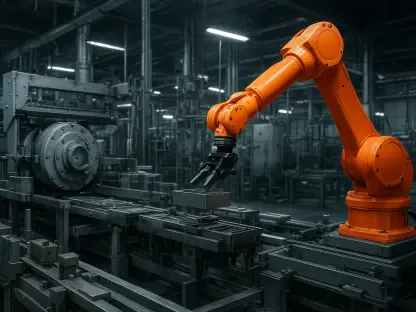
When a digital vulnerability can manifest as physical movement in a three-dimensional space, the primary concern shifts from data integrity to the immediate physical safety of factory personnel. Collaborative robots are specifically engineered to work in close quarters with humans, often without the heavy protective caging required for traditional industrial machinery. If a hijacked unit is programmed to ignore its internal force-limiting sensors or torque monitors, it transforms from a helpful assistant into a lethal piece of unguided hardware. An attacker could force the robotic arm to perform high-speed, erratic motions that are impossible for a human worker to anticipate or avoid. Such a collision could result in catastrophic injuries, especially in tight assembly line configurations where space is limited. The psychological impact of losing trust in a machine that is supposed to be “safe by design” would likely cause widespread disruption as workers remain wary.
Beyond the threat to human life, the financial and operational consequences of such a hijacking are profound enough to cripple a global supply chain within hours. A cybercriminal who gains control over the PolyScope environment can do much more than just stop a machine; they can subtly alter precision settings to ensure that products appear correct but fail under stress. This form of industrial sabotage is particularly insidious because it might take weeks or even months for the defective units to be discovered in the field, leading to massive recalls and reputational ruin. Furthermore, the threat of ransomware in this context takes on a new, more physical dimension, as attackers could hold an entire production line hostage by threatening to permanently damage the expensive robotic joints through overextension. In an industry where profit margins are razor-thin, the ability for a remote entity to dictate the operational status of a factory floor provides unparalleled leverage.
Implementing Robust Defense-in-Depth Measures
While Universal Robots moved quickly to release PolyScope version 5.25.1 to address the vulnerability, the structural challenges of industrial maintenance often delay the deployment of such critical patches. Many factory managers are understandably reluctant to pause production for a software update, fearing that the reboot process might introduce new mechanical issues or result in missed delivery targets. However, this hesitation creates a prolonged exposure window that sophisticated threat actors are eager to exploit. Modern manufacturing security can no longer rely on the outdated “air-gap” myth, as most modern facilities require some level of connectivity for remote monitoring and predictive maintenance. The discovery of CVE-2026-8153 served as a wake-up call, demonstrating that the speed of software updates must match the speed of the emerging threat landscape. Relying on perimeter security is no longer sufficient when a single compromised device inside the fence can lead to a total robotic hijacking.
To counter these risks, industry leaders pivoted toward a defense-in-depth strategy that prioritized internal network segmentation and continuous traffic monitoring. Engineers implemented rigorous isolation protocols, ensuring that robotic controllers resided on dedicated subnets that were inaccessible from the general office network or the public internet. Security teams deployed advanced intrusion detection systems that recognized the specific command signatures associated with the Dashboard Server exploit, allowing them to kill malicious connections in real time. Organizations also adopted a culture of proactive maintenance, where security patches were integrated into regular downtime schedules rather than being treated as optional tasks. By treating cybersecurity as a fundamental component of physical safety, manufacturers successfully reduced their attack surface and protected both their human workers and their financial assets. These actions transformed the industrial landscape into a more resilient environment.