
Industrial floors across the globe are currently witnessing a seismic shift as the boundary between digital logic and kinetic motion disappears into a unified layer of physical intelligence. High-precision manufacturing has historically relied on static automation, but the recent collaboration between Grid Dynamics and Doosan Robotics introduces a paradigm where machinery possesses the cognitive depth to interpret and react to its environment autonomously. This partnership serves as a bridge for enterprises struggling to reconcile high-level software orchestration with the brute requirements of industrial hardware. By merging these distinct capabilities, the initiative makes it feasible for modern businesses to deploy sophisticated automated systems that perceive, learn, and interact with their surroundings in ways previously reserved for the human workforce. The result is a shift from rigid assembly lines to dynamic, self-correcting ecosystems that redefine productivity and operational resilience in a competitive global market.
Synergy: Physical AI and Collaborative Robotic Systems
At the core of this industrial evolution lies the Physical AI stack, a specialized ecosystem where machine learning algorithms and physical hardware are no longer treated as separate entities. Traditional automation has long been criticized for its inability to deviate from pre-programmed paths, leading to significant downtime whenever unexpected variables occurred on the production floor. In contrast, this new framework utilizes real-time data streams to allow robots to adjust their behavior based on sensory feedback. Grid Dynamics and Doosan Robotics have focused on creating a seamless feedback loop that processes environmental data instantly, ensuring that the robotic units can navigate complex spaces without the need for constant human intervention. This leap in capability allows for a more fluid integration of technology into existing workflows, ensuring that the machinery is as adaptable as the software driving it today.
The hardware implementation of this intelligence is primarily seen in the deployment of collaborative robots, or cobots, which operate without the restrictive safety cages common in older factories. These machines are equipped with sophisticated force and torque sensors that provide a high degree of spatial awareness and tactile sensitivity. Because they are designed to work in close proximity to human employees, safety is not just a secondary feature but a fundamental aspect of their design. These sensors allow the cobots to detect the slightest resistance or obstruction, preventing accidents before they occur while maintaining high operational speeds. This blend of safety and power makes them ideal for varied tasks ranging from light assembly to heavy-duty material handling. By removing the physical barriers between humans and machines, companies can foster a more collaborative and efficient workspace that leverages the strengths of both parties.
Frameworks: Digital Architectures and Strategic Deployment
Intelligence within this ecosystem is governed by the GAIN Platform, an AI-native architecture developed by Grid Dynamics to serve as the central nervous system for industrial operations. This platform does not merely execute commands but utilizes Digital Twin simulations powered by NVIDIA Omniverse to create high-fidelity virtual replicas of the entire factory floor. Before any hardware is physically installed or a new production run begins, engineers can simulate thousands of scenarios to optimize workflows and identify potential bottlenecks in a risk-free digital environment. This predictive capability ensures that when the physical robots are finally activated, they are already calibrated for maximum efficiency based on comprehensive data analysis. The use of digital twins significantly reduces the time and cost associated with trial-and-error testing, providing a clear path from conceptual design to full-scale industrial execution for global enterprises.
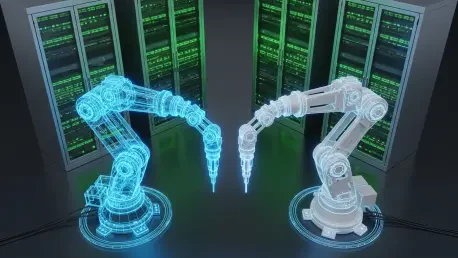
To further enhance the autonomy of these systems, the integration of Vision-Language-Action (VLA) models enables robots to interpret complex visual data and respond to spoken or written instructions. This shift moves away from traditional coding and toward a more intuitive interaction model where operators can direct robotic tasks using natural language. For instance, a dual-armed robot can be instructed to perform intricate assembly tasks that require high levels of synchronization, such as connecting wiring harnesses or assembling small electronic components. The VLA models allow the robot to “see” the parts, understand their orientation, and execute the necessary movements with human-like precision. This level of cognitive processing is essential for handling tasks that involve high variability, where the robot must decide the best course of action based on the current state of the assembly rather than following a rigid set of instructions.
The transition toward Physical AI required a calculated approach where manufacturers identified specific bottlenecks before deployment. It was observed that the most successful implementations prioritized the integration of sensory feedback loops with existing legacy hardware to minimize initial capital expenditure. Strategy focused on establishing a digital twin baseline before physical robots were even unboxed, ensuring that all safety parameters were met in a virtual environment. Organizations that adopted these turnkey solutions experienced a significant reduction in the time required to achieve full operational capacity. Looking back, the synergy between Grid Dynamics and Doosan Robotics provided the necessary blueprint for a scalable and intelligent industrial future. These efforts ultimately demonstrated that the key to modern efficiency lay in the seamless orchestration of software and hardware into a single, cohesive unit.