
The massive shift toward autonomous factory operations has moved beyond the realm of theoretical pilots and into a phase of deep, integrated application across the global manufacturing landscape. Today, the convergence of high-level software and heavy machinery is no longer just a competitive advantage but a fundamental necessity for survival in an increasingly volatile global market. Leading this charge are industrial titans Siemens and IFS, two entities that have shifted their focus from general automation to specialized, domain-specific artificial intelligence. By embedding advanced machine learning directly into the core of the product lifecycle and asset management systems, these companies are effectively bridging the gap between digital dreams and physical reality. This evolution is characterized by a move away from generic data lakes toward context-aware intelligence that understands the specific physics of a turbine or the intricate logistics of a global supply chain, ensuring every byte of data translates into tangible value.
Scaling Generative Intelligence on the Factory Floor
Siemens: Empowering the Industrial Copilot
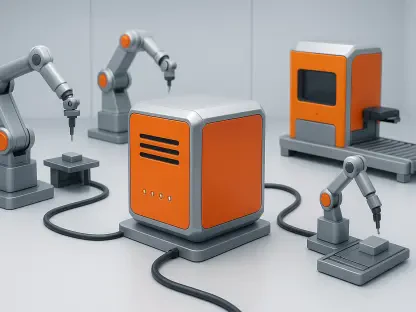
The introduction of the Siemens Industrial Copilot has fundamentally altered how engineers interact with complex automation systems by providing a generative interface for programmable logic controller development. Instead of spending weeks manually scripting code for robotic arms or conveyor belts, technicians now use natural language prompts to generate robust, error-free logic that can be deployed across the Siemens Xcelerator platform. This shift significantly reduces the technical barrier to entry for advanced manufacturing, allowing workers to focus on high-level process optimization rather than the minutiae of syntax. Furthermore, the collaboration between Siemens and Microsoft has enabled a seamless flow of information between the office and the shop floor, ensuring that design intentions are perfectly reflected in machine behavior. This integration speeds up the commissioning phase of new production lines by up to thirty percent, marking a major milestone in agile industrial output.
IFS: Revolutionizing Asset Lifecycle Management
While Siemens focuses on the mechanics of automation, IFS is redefining how organizations manage the entire lifecycle of their physical assets through the IFS Cloud platform. The integration of specialized AI models allows companies to move from reactive maintenance to a sophisticated, autonomous strategy that predicts failures before they occur with startling accuracy. By analyzing historical performance data alongside real-time sensor feeds, the system identifies subtle patterns that indicate wear and tear, automatically scheduling service interventions during periods of low production. This proactive approach does more than just save money; it extends the operational life of expensive machinery and ensures that service teams are dispatched only when necessary, with the exact parts required for the job. Consequently, organizations utilizing these IFS tools have reported significant improvements in uptime and a reduction in emergency repair costs, proving that intelligence is the most valuable resource in asset management.
Building the Infrastructure for Autonomous Operations
The Industrial Metaverse: Connecting Realities
The concept of the industrial metaverse has transitioned from a futuristic vision into a practical tool for complex engineering, largely thanks to the strategic partnership between Siemens and NVIDIA. By leveraging high-fidelity digital twins that are synchronized in real-time with their physical counterparts, manufacturers can simulate entire production environments with extreme precision. These simulations account for physics, heat distribution, and human ergonomics, allowing for the optimization of factory layouts before a single piece of equipment is installed. This capability is particularly vital for industries with tight margins or high safety requirements, as it allows for risk-free experimentation in a virtual space. Moreover, the ability to visualize data in an immersive environment helps stakeholders across the organization understand complex operational bottlenecks that would be invisible on a standard 2D dashboard, leading to more cohesive decisions.
Sustainability: Driving the Circular Economy Forward
Transitioning to a more sustainable industrial model required a level of transparency and data granularity that was previously impossible without the latest advancements from IFS and Siemens. The industry integrated ESG tracking directly into core enterprise asset management functions, enabling businesses to monitor their carbon footprint and resource consumption at a granular level. This was not just about compliance with environmental regulations; it was about optimizing the use of energy and raw materials to drive down costs while improving the brand’s environmental standing. By applying AI to supply chain logistics, firms identified the most efficient routes and methods for transporting goods, further reducing the total impact of operations. These strategic moves demonstrated that industrial success and environmental stewardship were no longer mutually exclusive goals, setting a new standard for the entire global manufacturing sector.