
When an aerospace engineer discovers a critical design flaw during the final assembly of a satellite housing, the cost of rectification often outweighs the initial budget allocated for the entire structural component. In the current industrial landscape, the traditional disconnect between conceptual design and physical manufacturing has long been a bottleneck for innovation, leading to wasted materials and delayed product launches. Norck, a precision manufacturing firm based in Irvine, California, has emerged as a disruptive force by strategically integrating advanced engineering intelligence with high-capacity production workflows. By bridging the gap between rapid prototyping and large-scale manufacturing, the company has positioned itself as a vital partner for engineering teams working in high-stakes fields like aerospace, medical technology, and robotics. This transition from a simple service provider to a strategic technology partner represents a fundamental shift in how sheet metal fabrication is approached today. The focus is no longer just on the quantity of machinery but on the quality of the data and engineering expertise applied to every bend, cut, and weld, ensuring that even the most complex geometries are realized with absolute fidelity to the original design.
Comprehensive Management of the Manufacturing Lifecycle
Norck has moved beyond the traditional role of a sub-contractor to manage the entire lifecycle of a component, effectively acting as an extension of the client’s internal engineering department. This comprehensive management strategy encompasses every stage of the production process, from the initial design review and material selection to the final finishing and complex assembly of multi-part systems. By consolidating these disparate steps under a single point of accountability, the organization eliminates the friction typically encountered when transitioning a product from a conceptual prototype to a full-scale factory floor. This holistic perspective allows for a more nuanced understanding of how individual parts interact within a larger assembly, reducing the likelihood of tolerance stacking issues that often plague projects involving multiple vendors. In an environment where technical specifications are increasingly stringent, this end-to-end approach ensures that every component is tracked and optimized for its specific application, providing a smoother and more predictable path to market for high-stakes hardware. Furthermore, by maintaining control over the entire process, the team can implement real-time adjustments that respond to shifting project requirements without compromising the integrity of the final product.
A central pillar of this redefined manufacturing strategy is the delivery of Engineering Intelligence as a Service, which integrates deep technical expertise into the early phases of development. By offering comprehensive Design for Manufacturability (DFM) reviews, the firm identifies potential production hurdles—such as improper bend radii, suboptimal hole placement, or impractical flange lengths—long before any physical material is processed. This proactive stance significantly lowers production costs by preventing the waste of expensive alloys and reducing the need for iterative prototyping cycles that can drain project budgets. Moreover, these evaluations improve the structural integrity of the final parts by suggesting modifications that align with the physical limitations of sheet metal behavior, such as grain direction and material thickness. By ensuring that the finished product perfectly matches the original design intent without the need for costly mid-production corrections, this intelligence-driven model provides a level of certainty that is essential for industries like aerospace and medical technology. The result is a more resilient supply chain where engineering precision is baked into the process from the very first digital model, allowing for a seamless transition into mass production.
Scaling Production Through Digital Infrastructure and Innovation
The infrastructure supporting these advanced fabrication processes is specifically built to handle varying production volumes, providing the essential flexibility required by modern global industries. Whether a client requires a single high-precision prototype for functional testing or a high-volume production run of several thousand units to meet market demand, the available resources scale accordingly without sacrificing quality. This adaptability is critical for sectors characterized by volatile requirements or rapidly evolving technical specifications where speed-to-market serves as a decisive competitive advantage. By maintaining a modular production environment, the facility can pivot between different material types and thicknesses with minimal downtime, ensuring that lead times remain consistent regardless of the project’s scale. This capacity for rapid scaling allows engineering firms to grow their product lines organically, starting with small batches to validate market fit before committing to the massive capital expenditures associated with traditional large-scale manufacturing. This bridge between low-volume custom work and high-volume industrial output represents a significant evolution in manufacturing capability, offering a tailored experience that adapts to the lifecycle of the product itself.
Beyond physical production, the company is leading a digital transformation of the procurement process by streamlining how engineers and purchasing managers source custom mechanical parts. Their focus on fast technical quotations and integrated online cutting services reflects a broader shift toward a more transparent, data-driven methodology that prioritizes efficiency. This digital-first approach allows procurement teams to receive comprehensive technical evaluations and detailed pricing almost instantaneously, which significantly shortens the overall development cycle and facilitates more agile project management. By automating the more administrative aspects of the bidding process, the system allows engineers to spend more time on innovation and less time on the logistics of vendor management. This transparency also extends to the tracking of materials and production status, giving clients a clear view into the progress of their orders and enabling more accurate forecasting for their own assembly lines. As industries move toward more decentralized and just-in-time manufacturing models, these digital tools become indispensable for maintaining the speed and accuracy necessary to compete in the global marketplace, ensuring that the supply chain remains as innovative as the products it supports.
Advanced Technical Proficiency in Precision Cutting and Forming
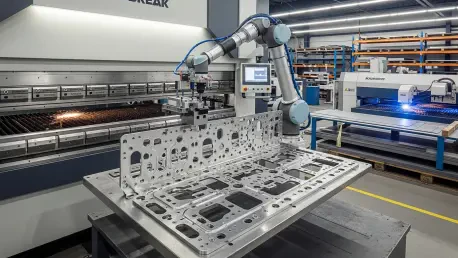
To deliver the high-precision results demanded by modern engineering applications, the facility utilizes a diverse array of advanced cutting technologies, including high-power laser, precision plasma, and abrasive waterjet cutting. Each of these methods is carefully selected based on the specific material properties, thickness, and the edge quality required for the final application, ensuring optimal results for every part. For instance, laser cutting is typically prioritized for intricate profiles and aerospace-grade components where narrow kerf widths and high tolerances are paramount for performance. In contrast, waterjet cutting provides an ideal solution for materials that are sensitive to heat-affected zones, such as certain specialized aluminum alloys or composite materials that might warp under thermal stress. This technical versatility allows for the processing of a wide range of materials, from standard carbon steel to exotic metals used in specialized scientific equipment. By matching the right technology to the specific material constraints, the manufacturing process achieves a level of precision that minimizes secondary grinding or finishing operations, thereby preserving the original material integrity and reducing the total cost of ownership for the client.
The fabrication capabilities extend far beyond flat-pattern cutting to include complex three-dimensional forming processes such as CNC tube bending and deep drawing. These sophisticated operations require a deep understanding of material science, specifically regarding how different metals react to stress, grain orientation, and the inevitable effects of springback after the forming tool is released. By accurately predicting these physical behaviors using advanced simulation software, the engineering team can adjust tooling and trajectories to ensure that every bend meets exact angular specifications. Furthermore, by managing secondary operations such as specialized robotic welding, hardware insertion, and surface treatment in-house, the facility ensures that multi-part assemblies fit together with perfect alignment. This vertical integration eliminates the common tolerance issues and logistical delays that occur when a project is passed between multiple specialized vendors, each with different quality standards. When a single entity oversees the transition from a flat sheet to a complex, welded, and finished assembly, the resulting component exhibits a level of structural consistency and aesthetic quality that is difficult to achieve through traditional fragmented manufacturing workflows.
Strategic Impact and Engineering Optimization for Specialized Industries
One of the most impactful aspects of this integrated manufacturing model is the heavy emphasis placed on geometric optimization to ensure long-term production viability. The internal engineering team works closely with clients to adjust critical features like flange lengths and hole-to-edge distances, ensuring that parts can be manufactured reliably using standard tooling whenever possible. This focus on material utilization and waste reduction not only simplifies the manufacturing process but also provides a clear financial advantage during high-volume production runs where even small efficiencies lead to significant cost savings. By optimizing the nesting of parts on a raw sheet of metal, the system maximizes the output per unit of raw material, which is particularly important as the cost of specialized alloys continues to fluctuate. This approach also considers the ergonomic and logistical aspects of assembly, suggesting modifications that make the final parts easier to handle and install on the end-user’s production line. This level of consultative engineering transforms the relationship from a transactional vendor interaction into a strategic partnership focused on maximizing the value and performance of every component produced.
This integrated approach has a profound impact on specialized industries that demand absolute precision and rigorous adherence to international quality standards. In the aerospace and defense sectors, where failure is not an option, the focus remains on structural integrity, material traceability, and comprehensive documentation for every part produced. Similarly, the medical and semiconductor industries rely on precision-formed enclosures and internal chassis components to protect sensitive electronics and maintain sterile or controlled environments. By combining advanced manufacturing technology with deep engineering support, the organization provides a reliable pathway for technical innovation across a variety of essential global markets that require more than just a simple part-to-print service. The ability to produce complex components that meet these high standards consistently allows innovative firms to push the boundaries of what is possible in robotics, renewable energy, and deep-sea exploration. As global demand for smarter and more durable hardware grows, the necessity for a fabrication partner that understands both the physics of the material and the economics of the market becomes a fundamental requirement for any successful engineering project.
Driving Long-Term Value Through Systematic Process Integration
The evolution of precision fabrication reached a critical milestone when the industry shifted toward a model that prioritized integrated engineering intelligence over isolated machining tasks. It became clear that the most successful hardware projects were those that bridged the historical divide between design intent and manufacturing reality through proactive collaboration. Manufacturers that invested in digital procurement tools and comprehensive Design for Manufacturability reviews successfully reduced lead times while increasing the reliability of their complex assemblies. This transition allowed engineering teams to focus on their core innovations, confident that their fabrication partners could manage the intricate details of material behavior and production scaling. As a result, the standard for excellence in the sector moved away from mere throughput toward a more holistic definition of value that included technical consultation and geometric optimization. Moving forward, the industry stabilized around these integrated workflows, ensuring that precision remained the primary driver of industrial progress. Organizations that embraced these systematic changes effectively future-proofed their production capabilities and maintained a competitive edge in an increasingly sophisticated global economy.