
The transition of large-scale additive manufacturing from a specialized prototyping technique into a primary method for producing certified industrial components represents a fundamental shift in the global production landscape. For decades, the high costs associated with traditional composite fabrication, such as complex tooling and extensive manual labor, limited the use of these materials to only the most expensive aerospace projects. Today, the manufacturing sector is witnessing a radical departure from these constraints as robotic 3D printing provides a viable pathway to fabricate massive, lightweight structures that were once considered impossible to build efficiently. This technological leap is not merely about speed; it is about redefining the geometric possibilities of structural engineering while drastically reducing material waste. As industrial sectors like maritime and rail seek more sustainable and agile production methods, robotic 3D printing has emerged as a cornerstone of modern smart manufacturing, enabling a digital-to-physical workflow that bypasses the limitations of the past.
Breaking the Limitations: Modern Manufacturing
Unlocking Geometrical Flexibility: Six-Axis Robotics
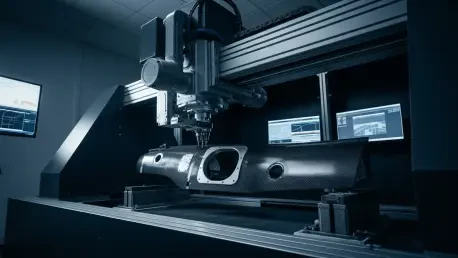
Standard manufacturing systems often rely on three-axis gantries that are limited by a linear approach to material deposition, which frequently necessitates the use of extensive support structures for complex parts. This limitation not only increases the amount of wasted material but also restricts the design of parts with intricate internal geometries or steep overhangs. By contrast, the adoption of six-axis industrial robotic arms allows for a much more fluid and dynamic printing process where the print head can move around the part in a multi-directional fashion. This non-planar printing capability enables the material to be deposited along the precise lines of stress that the part will encounter during its operational life. The result is a significant improvement in the mechanical properties of the final composite, as the fiber orientation can be optimized for maximum strength. This shift ensures that large-scale components are both lighter and more durable than their predecessors produced by older methods.
The success of these multi-axis systems is further enhanced by the development of vertically integrated software that bridges the gap between digital design and physical execution. Modern path-planning algorithms now account for the complex kinematics of robotic arms, ensuring that the movement is smooth and the extrusion is perfectly synchronized with the speed of the robot. This synchronization is critical when dealing with high-temperature thermoplastics that require precise thermal management to prevent warping or delamination in large structures. Sensors integrated into the print head provide constant feedback to the control system, allowing it to adjust for minor variations in material flow or ambient temperature during the print. This holistic approach to automation turns the robotic arm into a highly reliable production tool capable of maintaining tight tolerances over long print cycles. These advancements have made it possible to produce industrial-grade parts with minimal human intervention, ensuring consistent quality.
Streamlining Production: Mouldless Techniques
Traditional composite production is notoriously slow due to the necessity of creating high-precision molds, which can take weeks or even months to manufacture and prep for use. Robotic 3D printing effectively eliminates this bottleneck by printing the near-net-shape part directly from a digital file, bypassing the need for expensive and wasteful tooling. This approach is particularly advantageous for the production of low-volume, high-complexity parts where the cost of a traditional mold would be prohibitively expensive. By depositing material only where it is needed, manufacturers can achieve a level of material efficiency that is impossible with subtractive methods. The printed part serves as its own structural base, reducing the total number of steps in the manufacturing process and allowing for much faster design iterations. This move toward tool-less fabrication is transforming the financial model of composite manufacturing, making custom production more accessible to a wider range of high-performance industries.
To complement the speed of the printing process, many industrial facilities are implementing hybrid techniques that combine 3D printing with traditional reinforcement methods. In this scenario, a robotic system prints a complex internal core or substrate which is then finished with a layer of continuous glass or carbon fiber lamination. This hybrid workflow leverages the geometric freedom of additive manufacturing while ensuring the final part possesses the high impact resistance and structural stiffness required for heavy-duty applications. It allows for the creation of lightweight, hollow structures that would be extremely difficult to produce using conventional hand lay-up techniques. Furthermore, the ability to print functional features like mounting points and internal channels directly into the structure reduces the need for secondary assembly and machining. This synergy between different manufacturing styles is creating a more versatile production environment where complexity no longer carries a significant cost penalty for the end user.
Validating Performance: Industrial Certification
The transition of robotic 3D printing into the mainstream is marked by its successful certification in industries with the most demanding safety and durability requirements. In the rail sector, manufacturers are now using 3D-printed composite components for both interior and exterior components that meet international fire, smoke, and toxicity standards. These parts are subjected to rigorous testing to ensure they can withstand the mechanical loads and environmental conditions of long-term service. Similarly, the maritime industry has seen the successful deployment of printed structural components in high-performance yachts and commercial vessels. The ability to print large-scale parts that are resistant to corrosion and UV degradation has opened up new possibilities for naval architects. These real-world applications serve as critical validation points, demonstrating that additive manufacturing is no longer just for prototypes but is a mature technology capable of delivering end-use parts for critical infrastructure.
To ensure the long-term success of these technologies, organizations established robust digital infrastructures that utilized IoT platforms and machine learning for real-time quality control. They prioritized the development of digital twins to simulate the manufacturing process, which allowed engineers to identify and correct potential flaws before production began. This data-driven approach was complemented by investments in specialized training programs that prepared the workforce for a new era of automated production. Companies also worked closely with regulatory bodies to standardize testing procedures for printed composites, ensuring that every part met the same high quality benchmarks. These strategic actions minimized the risks associated with adopting new technologies and paved the way for broader integration in aerospace and space exploration. Ultimately, the industry moved away from static manufacturing methods toward a more flexible, intelligent system that provided a clear path for the future of large-scale industrial design.