
The transition from traditional assembly lines to integrated learning systems represents the most significant shift in industrial history since the introduction of the moving conveyor belt over a century ago. Major automotive players such as BMW, Volkswagen, Audi, and the global supplier Schaeffler have moved past the experimental phase of digital manufacturing to create factories that think, adapt, and optimize in real-time. This evolution, often referred to within the industry as the “Digital Factory,” is not merely about replacing human labor with machines, but about creating a scalable, economical, and resilient ecosystem capable of handling the extreme complexity of modern electric vehicle production. As electric axles now contain over 1,200 individual components, the need for total transparency across the global supply chain has transformed digitalization from a high-level corporate goal into a fundamental practical tool. Modern manufacturing has become a high-tech, data-driven environment where every sensor and every robot serves as a node in a massive, interconnected intelligence network. This shift ensures that production remains viable even as global logistics become more volatile and consumer demands for customization reach unprecedented levels across the international market.
The Evolution: From Visual Models to Operational Control
The core of this industrial transformation lies in the maturity of the “Digital Twin,” which has evolved from a static 3D architectural drawing into a dynamic, functional control mechanism that governs the entire production lifecycle. This process begins long before a single brick is laid or a machine is bolted to the floor, starting with the creation of a digital master. This master acts as a comprehensive blueprint for the site, allowing engineers to simulate workflows, test ergonomic layouts for human workers, and verify the physical placement of robotics in a virtual environment. By perfecting the factory layout virtually, manufacturers avoid the costly “trial and error” phase that historically plagued new production launches. This proactive approach ensures that the physical infrastructure is optimized for maximum throughput from the very first day of operation, drastically reducing the time-to-market for new vehicle models and allowing for a more agile response to changing consumer preferences in a competitive global landscape.
Once the physical factory is operational, the digital master is augmented by what experts call a digital shadow, which provides a continuous, live stream of performance data from the shop floor. This shadow captures every movement, every temperature fluctuation, and every cycle time, creating a real-time reflection of the factory’s current state. The final and most critical stage is the fusion of the master and the shadow into a full, bidirectional Digital Twin. This setup allows engineers and plant managers to control and optimize production remotely, adjusting machine parameters or solving complex maintenance issues without needing to be physically present on the assembly line. This capability transforms the factory from a static, localized building into a flexible, global system that can be monitored and managed from any location in the world. It provides a level of operational transparency that was previously impossible, enabling a seamless transition between the virtual planning phase and the physical reality of automotive manufacturing.
Connecting Legacy Systems: The Challenge of Data Layers
For many established automotive manufacturers, the primary obstacle to modernization is not building new facilities, but rather updating “brownfield” sites—older factories that were never originally intended for the digital era. Companies like Schaeffler have successfully navigated this hurdle by connecting more than 10,000 diverse machines to a standardized, unified data layer that serves as the backbone for all digital operations. This massive connectivity project creates a foundation for advanced diagnostic tools, such as the Manufacturing Intelligence Assistant, which allows plant managers to interact with live production data through intuitive interfaces. Instead of sifting through massive daily reports or waiting for end-of-shift summaries, personnel can now receive instantaneous updates on machine health and efficiency. This immediate access to information allows for a more proactive management style, where potential issues are identified and mitigated before they can result in costly downtime or production delays.
This digital shadow functions much like a sophisticated navigation system for the factory floor, providing a high-level view of the entire manufacturing process. When a bottleneck occurs in a specific sector or a critical machine requires unscheduled maintenance, the system does not simply report the error; it analyzes the impact on the entire chain and suggests a “new route” to keep production moving. This level of agility is absolutely essential for managing the intricate logistics associated with electric mobility, where the supply of components like battery cells and electric motors is tightly synchronized. Even a minor delay in one region can have cascading effects on global operations, making the ability to reroute production or adjust schedules in real-time a key competitive advantage. By bridging the gap between legacy hardware and modern data analytics, automotive companies are ensuring that their existing assets remain productive and relevant in an increasingly automated world.
Solving the Small Data Problem: Specialized AI Logic
While the tech industry often relies on massive datasets gathered from millions of internet users, the automotive manufacturing sector frequently faces a “small data” problem because there are only a handful of major production sites and a finite number of machines. To overcome this limitation, companies like BMW are turning to “neuro-symbolic” AI, a hybrid approach that combines the flexibility of machine learning with the rigid, logic-based expert knowledge of human engineers. This ensures that the AI can suggest creative solutions for factory layouts or process optimizations while strictly adhering to essential engineering rules, such as weight limits for flooring or safety clearance for robotic arms. By using AI in this controlled, symbolic way, manufacturers can benefit from the speed of automation without the risks associated with the “black box” nature of traditional deep learning models. This approach creates a safer, more predictable environment where AI serves as an assistant to human expertise rather than a replacement for it.
This shift toward “agentic planning” allows engineers to deploy AI agents to handle the tedious and complex task of assessing thousands of different production variants in a fraction of the time it would take a human team. For instance, when designing a new assembly cell, an AI agent can run simulations of various equipment configurations to find the one that minimizes energy consumption while maximizing output. Collaborations between carmakers and software providers have also accelerated this process by allowing AI to automatically generate complex 3D simulations from simple text-based instructions. This can reduce the time spent on simulation and planning by as much as 90%, freeing up human engineers to focus on higher-level strategy and quality control. However, despite the incredible speed of these systems, the human element remains vital, as workers must still establish the initial boundary conditions and verify the AI’s output to ensure that every suggested change meets the rigorous safety and quality standards of the automotive industry.
Physical AI: Enhancing Robotic Perception and Dexterity
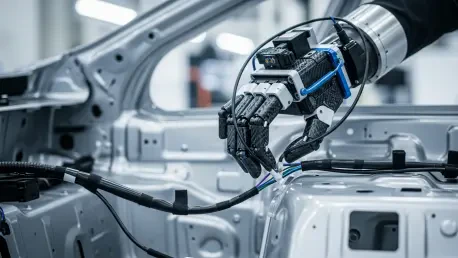
Volkswagen and Audi are currently leading the charge into the realm of “Physical AI,” an initiative aimed at giving machines the intelligence required to interact more naturally and fluidly with the physical world. Traditional industrial robots were designed to perform repetitive, highly predictable tasks in a strictly controlled environment, but modern automotive production requires a much higher degree of adaptability. By integrating advanced sensors and computer vision, manufacturers are creating robots that can perceive their surroundings and make real-time adjustments to their movements. This capability is particularly crucial in tasks that were once considered too unpredictable for automation, such as the handling of flexible cables or the assembly of intricate battery modules. By making robots more perceptive, companies can reduce the engineering effort required to program these machines by nearly 70%, allowing for faster deployment and greater flexibility on the line.
One of the most practical applications of this technology is found in battery assembly, where robots use camera data and synthetic training models to identify and manipulate objects that do not have a fixed shape. In the past, a robot would struggle to pick up a loose wire or a flexible connector, but with Physical AI, the machine can “understand” how the object will react to being moved and adjust its grip accordingly. Similar advancements are being made in logistics, where autonomous systems are learning how to unpack parts and sort varied packaging materials—tasks that require a high degree of visual awareness and manual dexterity. These smart robots allow factories to remain competitive even in regions with high labor costs, as they can handle a wider variety of tasks with minimal human intervention. As these systems continue to learn from their environments, they become more efficient over time, contributing to a self-optimizing production cycle that continuously improves its own performance.
The Shift: Decoupling Software from Industrial Hardware
Audi is championing a significant technological shift toward “software-defined” automation, which seeks to break the historical link between a robot and its specific, proprietary hardware controllers. For decades, industrial automation was locked into a model where each machine required its own dedicated chip and specialized software, making it difficult to update or scale operations across an entire factory. Audi’s vision involves running these automation functions as virtualized containers within a central data center or an industrial edge cloud, rather than on a physical controller attached to the machine itself. This decoupling allows for much greater scalability, as the “brain” of the factory can be upgraded or expanded without needing to physically modify every individual robot on the assembly floor. It also enables a centralized control system to manage entire fleets of robots simultaneously, optimizing their paths and speeds in real-time to eliminate idle time and maximize overall efficiency.
Moving toward a standardized, scalable hardware environment also helps to significantly reduce long-term maintenance costs and simplifies the process of integrating new technology into the production line. When the control logic is hosted in a virtualized environment, engineers can push software updates or new operating parameters to thousands of machines with the click of a button, ensuring that the entire factory is always running the most current and efficient code. This transition to software-defined manufacturing mirrors the transformation seen in the telecommunications and IT sectors, where specialized hardware was replaced by versatile, software-driven solutions. By adopting this model, automotive manufacturers are creating a more resilient infrastructure that is less dependent on specific hardware vendors and more capable of evolving alongside the rapid pace of technological innovation. This flexibility is key to maintaining a competitive edge in a global market where the ability to rapidly pivot production strategies is increasingly valuable.
Humanoid Robotics: Navigating the Gap Between Hype and Reality
There is an ongoing and vigorous debate within the automotive sector regarding the potential role of humanoid robots on the factory floor. While these machines have performed impressively in controlled laboratory demonstrations, they currently face significant challenges regarding the durability and precision required for 24/7 industrial shifts. Most current AI models governing humanoid movement and task execution have a success rate hovering around 85%, which, while impressive for a research project, falls well short of the 99.9% reliability required for high-stakes automotive assembly. The mechanical complexity of humanoids also makes them more prone to failure than specialized industrial robots, leading to concerns about maintenance costs and potential disruptions to the assembly line. Despite these hurdles, there is a strong strategic push to develop this technology, particularly within Europe, to ensure industrial sovereignty and avoid complete dependence on outside technology providers for the next generation of automation.
The long-term goal for humanoid robotics is not to replace existing automation, but to fill the gaps in the production process where human-like flexibility and situational awareness are required. For now, the focus remains on finding the right balance between the high-speed precision of traditional robotics and the unique problem-solving capabilities of human workers. While humanoid robots may eventually become a viable part of the industrial workforce toward the 2030s, the current priority is developing the underlying software and sensor technologies that will make them safe and effective colleagues. Manufacturers are investing heavily in research and development to ensure that when these machines finally reach industrial maturity, the infrastructure to support them is already in place. Until then, the human worker remains the most adaptable and intelligent asset on the factory floor, providing the critical oversight and creative thinking that even the most advanced AI systems have yet to replicate.
Implementing Resilient Systems: Strategic Next Steps
The integration of AI and robotics in the automotive sector reached a critical turning point as manufacturers transitioned from isolated pilot projects to holistic, factory-wide implementations. The industry moved toward a hybrid model where data-driven insights and physical automation worked in tandem to solve the most pressing challenges of electric vehicle production. To maintain this momentum, companies focused on standardizing their data protocols and investing in the training of their workforce to ensure that employees were equipped to manage these complex digital systems. By prioritizing the creation of a Unified Namespace, manufacturers ensured that data from the smallest sensor could be used by the highest-level AI planning agents, creating a truly transparent and responsive manufacturing environment. This approach allowed the industry to absorb the shocks of global supply chain disruptions while continuing to push the boundaries of what was possible in terms of production speed and product quality.
Looking forward, the successful automotive factory remained one that valued flexibility over rigid automation, recognizing that the ability to adapt to new technologies was more important than the technologies themselves. Manufacturers began to treat their factories as living products, subject to constant software updates and iterative improvements based on real-time performance metrics. This mindset shift encouraged a culture of continuous innovation, where engineers and line workers collaborated to identify new ways to leverage AI and robotics for better outcomes. As the focus shifted toward sustainable and decentralized manufacturing, the lessons learned from the digitalization of the 2026 factory provided a roadmap for other industries to follow. The ultimate goal was to create a production environment that was not only efficient and profitable but also resilient enough to thrive in an unpredictable global economy, ensuring that the automotive industry remained a cornerstone of technological progress for years to come.