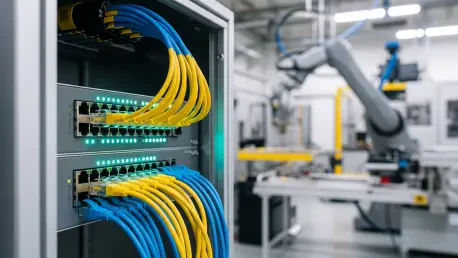

The seamless operation of a high-tech assembly line often masks a precarious reality where sophisticated robotics depend on networking protocols designed well before cyber warfare became a standard global threat. The modern manufacturing floor is currently undergoing a profound transformation, driven by the ambitious goals of Industry 4.0 and the increasing integration of artificial intelligence into production workflows. As factories integrate advanced robotics, cloud analytics, and automated assembly lines, they increasingly rely on a digital backbone that was established decades ago. This transition has exposed a significant security paradox: while operational technology (OT) has become more interconnected, the underlying legacy Ethernet infrastructure remains rooted in an era when cybersecurity was an afterthought. This analysis explores whether these aging networks have become the most significant vulnerability in the industrial sector, examining the risks posed by the convergence of information technology (IT) and OT.
From Air Gaps to Always-On: The Evolution of Industrial Networking
Historically, factory environments operated in what was known as an air-gapped state, where physical isolation served as the primary defense mechanism. Operational technology—the hardware and software that controls industrial equipment—was physically and logically isolated from the outside world and corporate office networks. This isolation provided a natural defense; without a connection to the internet, the risk of a remote cyberattack was virtually nonexistent. During this period, Ethernet protocols were designed with a singular focus on uptime, reliability, and real-time performance rather than encryption or user authentication.
As the Industrial Internet of Things (IIoT) emerged, the demand for real-time data analytics and remote management necessitated the removal of these air gaps to maintain market competitiveness. The shift toward always-on environments has fundamentally changed the risk landscape for manufacturers globally. Foundational concepts that once prioritized mechanical endurance now clash with a digital world that demands constant patching and perimeter defense. Understanding this historical shift is essential to grasping why legacy Ethernet hardware, though still functionally reliable in a mechanical sense, is increasingly incapable of meeting the security demands of the modern era.
Unmasking the Critical Vulnerabilities Within the Ethernet Backbone
The Security Paradox: IT and OT Convergence
The convergence of IT and OT environments has drastically expanded the attack surface, providing more entry points for malicious actors. According to the National Institute of Standards and Technology (NIST), this connectivity is the primary driver of modern industrial risk, as it bridges the gap between secure office environments and vulnerable production floors. Advanced protocols like EtherCAT have enabled high-speed automation and the integration of thousands of devices, yet they simultaneously complicate network monitoring. In many legacy environments, devices lack unique IP addresses or the ability to communicate using standard IT security protocols, creating a visibility gap where security teams cannot easily verify the legitimacy of every endpoint.
The Structural Risks: Flat Networks and Unpatched Hardware
A significant challenge in legacy Ethernet environments is the prevalence of flat network architectures that lack internal barriers. Unlike modern IT networks that use segmentation to isolate different departments, many older factory networks allow any device to communicate with any other device. This lack of segmentation means that if an attacker gains access to a single low-security peripheral, such as a temperature sensor or a human-machine interface, they can move laterally across the entire network to reach critical controllers. Furthermore, much of the hardware in these environments runs on firmware that has reached end-of-life status, harboring known vulnerabilities that can be exploited by relatively unsophisticated attackers using automated tools.
Physical and Economic Consequences: The Real-World Impact
The risks associated with legacy Ethernet extend far beyond digital data loss; they manifest as physical hazards and significant economic catastrophes. When communication protocols lack encryption or authentication, attackers can spoof commands, potentially causing heavy machinery to malfunction or bypassing emergency shut-off systems. This places floor workers in direct physical danger while risking permanent equipment damage. Economically, the impact of a shutdown is staggering, as ransomware attacks on OT infrastructure can halt production lines for weeks. There is also the persistent threat of industrial espionage, where proprietary production methods and intellectual property are exfiltrated through the very Ethernet cables that were supposed to drive efficiency.
Looking Ahead: The Shift Toward Cyber-Resilient Infrastructure
The future of industrial networking is moving toward a model of security by design, where resilience is baked into the hardware rather than added as an afterthought. Emerging trends such as Time-Sensitive Networking (TSN) and the integration of 5G are beginning to offer the high-speed performance of legacy Ethernet with the added benefit of modern encryption and authentication standards. We are also seeing a shift in the regulatory landscape, with new mandates requiring manufacturers to provide a Software Bill of Materials (SBOM) for their industrial devices. Experts predict that the factories of the future will rely on zero-trust architectures, where no device is trusted by default, regardless of whether it is located inside the factory walls or in a remote data center.
Building a Modern Defense: Strategies for the Factory Floor
While replacing an entire factory networking infrastructure overnight is rarely feasible, manufacturers can adopt a defense-in-depth strategy to mitigate legacy risks. The most effective immediate step is network segmentation—using industrial firewalls and virtual local area networks to create zones that prevent the lateral movement of threats. Businesses should also prioritize targeted upgrades for bottleneck components, such as outdated switches that cannot support modern security protocols. Additionally, implementing continuous monitoring tools designed specifically for industrial traffic can help identify behavioral anomalies in real time. Finally, securing remote access through Multi-Factor Authentication (MFA) and encrypted VPNs is essential for preventing unauthorized entry into the OT environment.
Securing the Future: Lessons From the Industrial Evolution
Legacy Ethernet remained the lifeblood of many modern factories, but its inherent lack of security features made it an increasingly dangerous weak link in the production chain. As IT and OT continued to merge, the industry moved past the era of air-gapped security and embraced a proactive, layered approach to defense. Strengthening these networks was not merely a technical requirement; it represented a fundamental necessity for ensuring operational resilience and protecting human life. The transition was complex, but the market recognized that the cost of inaction was far higher than the investment in modern, secure infrastructure. Industry leaders eventually shifted their focus toward holistic resilience, ensuring that every connected sensor possessed a unique digital identity to neutralize lateral movement. This evolution proved that technical debt in networking was the most expensive form of liability for any modern manufacturer.