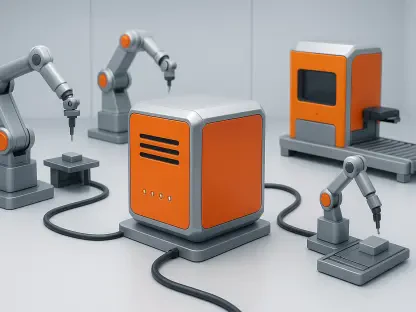

The rapid digital transformation of the factory floor has inadvertently created a dangerous paradox where manufacturers possess more automated tools than ever yet remain increasingly vulnerable to systemic disruptions. As the physical boundaries between Information Technology and Operational Technology continue to vanish, the ability to coordinate security measures without halting essential production has emerged as the primary differentiator between industry leaders and those struggling to keep pace. This analysis examines the urgent transition from isolated task automation toward comprehensive orchestration, covering adoption statistics, the widening coordination gap, and the future of AI-driven industrial resilience.
The current environment demands a move away from fragmented security solutions that treat factory assets as independent units. Instead, the focus is shifting toward a unified strategy where every automated action is part of a larger, synchronized workflow designed to protect both data and physical throughput. This shift is not merely a technical upgrade but a fundamental reimagining of how security operates within a high-stakes industrial context.
Evaluating the Current Landscape of Industrial Automation
Modern manufacturing landscapes are defined by an unprecedented level of connectivity, where sensors, robotics, and cloud-based management systems work in tandem to optimize efficiency. However, this hyper-connectivity has introduced significant complexity into the cybersecurity equation, making it difficult for teams to maintain a clear overview of their defensive posture. While automation has solved the problem of scale, it has also introduced new layers of opacity that can hide critical vulnerabilities from view.
Examining Growth Patterns: The Coordination Gap
Current data indicates that 56 percent of manufacturing organizations feel dangerously exposed to known vulnerabilities despite the widespread adoption of faster automated deployment cycles. This discrepancy exists because a coordination gap remains at the heart of most industrial security programs, where the speed of automated detection far outpaces the manual processes required for remediation. Consequently, manufacturers are beginning to shift their focus from activity metrics, such as the number of scans performed, toward risk reduction metrics that measure how effectively the window between discovery and neutralization is closing.
Moreover, the rise of AI-driven threats is forcing a move away from traditional manual approvals toward more dynamic, automated orchestration. As attackers use machine learning to identify and exploit weaknesses in real time, the reliance on human-led bureaucratic cycles becomes a liability. Organizations are now seeking systems that can evaluate risk contextually and execute responses with minimal human intervention, ensuring that the defense can match the velocity of the modern threat landscape.
Operationalizing Cybersecurity: Real-World Factory Environments
High-performing manufacturers are successfully navigating these challenges by utilizing pre-negotiated maintenance windows and sophisticated automated testing protocols to safeguard sensitive operational environments. By integrating security workflows directly into production schedules, these organizations ensure that critical patches are applied without risking unplanned downtime or damage to specialized equipment. This integration allows security to become a predictable part of operations rather than an external disruption that plant managers must work around.
Furthermore, the use of advanced orchestration is helping to eliminate the risks associated with shadow assets, such as unpatched third-party sensors and isolated legacy components. Many factory floors house a mix of cutting-edge technology and decades-old machinery that was never designed with internet connectivity in mind. Orchestration platforms provide the necessary visibility to track these disparate components, ensuring that even the most obscure or outdated parts of the network are included in the overall security strategy.
Industry Perspectives: Friction Between Security and Production
Security leaders frequently highlight the time-to-remediate crisis, where manual friction often offsets the technical speed gained by automated tools. In many cases, a security patch may be ready for deployment in minutes, but the approval process across multiple departments can take days or even weeks. This delay provides threat actors with a significant window of opportunity. Experts argue that the traditional conflict between uptime and security must be resolved through cross-departmental negotiation and the implementation of mature automation that assists in the decision-making stages.
There is a growing consensus that for automation to be effective in a high-stakes manufacturing context, it must move beyond simple execution to provide validation and situational awareness. Mature systems are expected to analyze the potential impact of a security action on a specific production line before it is taken. This level of intelligence allows for a more nuanced approach where security is prioritized in a way that respects the physical realities of the shop floor.
Projecting the Future: Resilient Manufacturing Workflows
The evolution of industrial systems is moving toward a future where security is not a separate layer but an inherent property of the manufacturing lifecycle. Systems are developing the capability to provide full-scale lifecycle orchestration, ensuring that every asset is monitored and maintained from installation to decommissioning. This approach will allow manufacturers to maintain global supply chain integrity by ensuring that every node in the network meets the same rigorous security standards, regardless of its location or age.
Artificial intelligence will play a critical role in this evolution by allowing for real-time adjustments to security protocols without risking equipment damage or the production of scrapped materials. As AI models become more adept at understanding the unique requirements of industrial processes, they will be able to orchestrate complex remediation tasks during the briefest of operational pauses. However, the continued reliance on legacy systems that resist modernization will remain a primary challenge, requiring innovative bridging technologies to ensure total network coverage.
Synthesis of Key Findings: Strategic Recommendations
The transition from a task-based mindset to a workflow-based strategy was identified as the essential path for achieving modern manufacturing resilience. Leaders recognized that the true value of cybersecurity technology was determined by its ability to reduce organizational risk without slowing the engine of production. Successful programs prioritized the elimination of manual bottlenecks, ensuring that security teams and operational managers worked from a shared set of data and objectives.
Moving forward, leadership evaluated their security programs based on tangible outcomes and the reduction of the coordination gap. Organizations that embraced mature orchestration found themselves better equipped to handle the speed of AI-driven attacks while maintaining the uptime necessary for global competitiveness. The focus shifted toward building scalable, frictionless systems that provided comprehensive visibility across both IT and OT environments, ultimately securing the long-term integrity of the manufacturing sector.