
The global industrial landscape is undergoing a monumental shift as legacy manufacturing facilities transform into hyper-connected, autonomous ecosystems that leverage real-time data to drive unprecedented efficiency. This evolution is pushing the Industry 4.0 market toward a staggering $1.14 trillion valuation, fueled by the convergence of high-speed connectivity and advanced machine learning. Manufacturers are no longer satisfied with reactive maintenance or siloed data; instead, they are investing heavily in integrated platforms that offer a holistic view of the entire supply chain. From the floor of a precision automotive plant to the control rooms of massive refineries, the integration of smart sensors and cloud computing has become the standard for remaining competitive in a volatile global economy. As companies strive to mitigate labor shortages and rising energy costs, the shift toward full automation has accelerated, turning the “smart factory” from a concept into the backbone of modern output.
The Technological Pillars: Foundations of the Smart Factory
Industrial Internet of Things: The Nervous System of Production
The rise of the Industrial Internet of Things serves as the primary catalyst for this expansion, acting as a sophisticated nervous system that bridges the gap between physical machinery and digital intelligence. By embedding advanced sensors into infrastructure, organizations can now capture granular performance metrics previously inaccessible to operators. For instance, a robotic assembly arm can transmit thousands of data points regarding torque and temperature, allowing AI algorithms to detect minute anomalies before they lead to mechanical failure. This transition from scheduled maintenance to predictive analytics reduces downtime and extends the operational life of expensive assets. Moreover, the rollout of private 5G networks provides the low-latency bandwidth necessary to support thousands of connections on a single factory floor. This ensures that data-driven decisions are made in milliseconds, creating a seamless flow of information that optimizes power consumption and reduces material waste in real-time.
Artificial Intelligence: Enhancing Decision-Making
Beyond simple connectivity, the integration of artificial intelligence into manufacturing workflows enabled a shift from human-led oversight to autonomous decision-making. By utilizing machine learning algorithms that process vast datasets, companies can now optimize supply chains and inventory management with surgical precision. These systems are capable of identifying patterns in consumer demand and adjusting production schedules accordingly, which prevents overproduction and reduces costs. In high-precision industries such as semiconductor fabrication, AI-driven computer vision systems inspect wafers for defects at speeds that exceed human capabilities. This implementation not only ensures higher product quality but also frees up human workers to focus on more complex, value-added tasks. As technology matures, the cost of implementing these systems has decreased, allowing smaller players to enter the space. The democratization of AI is a major contributor to market growth, leveling the playing field across the industrial sector.
Operational Strategy: Future-Proofing Production
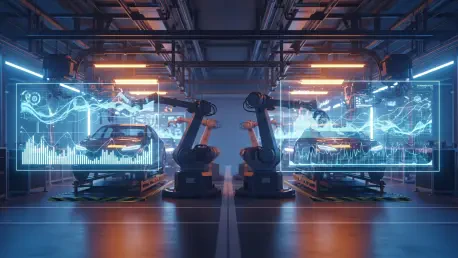
Virtualization technologies redefined the prototyping and operational phases of manufacturing by allowing engineers to create high-fidelity digital twins. These models are dynamic replicas that mirror the state of physical assets through continuous data synchronization. By running complex simulations, companies in aerospace or pharmaceutical sectors tested new workflows without risking damage to equipment. This capability allowed for the identification of potential bottlenecks before a machine was activated on the floor. Furthermore, the use of digital twins facilitated the training of autonomous robots in a risk-free setting. Organizations that prioritized these virtual environments achieved significant leads in operational agility and resource management. Moving forward, leaders should integrate these simulations with real-time supply chain data to enhance resilience against global disruptions. Staff training became a critical step in securing long-term profitability.