
Kwame Zaire is a distinguished voice in the defense manufacturing sector, bringing decades of expertise in high-end electronics and production management to the table. As a thought leader deeply invested in predictive maintenance and quality control, he has observed the intricate shift from traditional aerial platforms to the sophisticated, AI-driven systems currently being unveiled on the global stage. In this conversation, we explore the rise of “wingman” drones and the strategic pivot toward collaborative combat aircraft (CCA) in Europe. We delve into the technological demands of integrating autonomous swarms with manned jets, the critical importance of electronic warfare as seen in modern conflicts, and the logistical challenges of maintaining sovereign control over the artificial intelligence that serves as the “brain” of these next-generation weapons.
How do these collaborative combat aircraft integrate with manned fighter jets to fundamentally change the way air superiority is maintained?
The integration of collaborative combat aircraft, or CCAs, represents a massive leap from viewing drones as simple tools to seeing them as true “loyal wingmen.” When you look at a system like the MQ-28 Ghost Bat, you are seeing a force multiplier that allows a single human pilot to command a digital flock. These aircraft are designed to flank manned jets, extending their reach by carrying additional sensors, jammers, and weapons systems that would otherwise weigh down a primary fighter. By flying out ahead, these unmanned jets provide what we call decision-making quality information, fusing complex data streams into a clear picture for the human operator. It is a sensory experience where the pilot is no longer just flying a plane; they are managing a localized network that can sniff out threats and neutralize them before the enemy even knows they are being watched.
With companies like Helsing emphasizing a “sovereign brain” for these systems, what are the technical and strategic hurdles of developing independent AI for European defense?
The push for sovereignty is perhaps the most significant undercurrent in the European defense industry right now, especially as nations look to reduce their heavy reliance on American technology. When Stephanie Lingemann talks about the AI agent needing to be controlled in a sovereign fashion, she is referring to the core “brain” that dictates how these autonomous swarms react under fire. For countries like Germany and France, this means building a robust data network that can survive even when external communications are cut off. We saw this tension play out when plans for a joint fighter jet were initially shelved, leading to a pivot toward salvageable drone systems and shared data architectures. The manufacturing challenge here is immense, as every component of the AI must be vetted to ensure that the logic governing a drone’s response in a kinetic environment remains entirely under domestic control.
The war in Ukraine has highlighted the vulnerability of traditional communications; how is that reality shaping the development of electronic warfare capabilities in these new drones?
The conflict in Ukraine has been a brutal classroom for electronic warfare, proving that disrupting a sensor or a radio link can be just as devastating as a physical missile strike. Because of this, the next generation of drones, such as the U760b Ravenstorm being developed by Airbus, is being built with a heavy focus on resilience against jammers. We are moving toward autonomous swarms that can continue their mission even when they lose contact with the home base, using their internal AI to navigate and identify targets. At the Berlin airshow, it was clear that the industry is prioritizing electronic attack drones that work in tandem with strike drones to blind enemy radar. It’s a high-stakes game of hide-and-seek where the “wingman” provides a protective digital bubble, allowing the manned platform to remain undetected while the drones absorb the brunt of the electronic interference.
Given that many of these systems are still in the testing or prototype phase, what does the manufacturing and deployment timeline look like for the next decade?
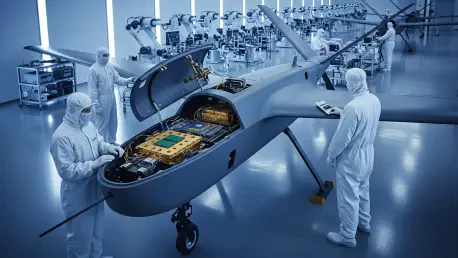
We are currently in a high-intensity testing phase where prototypes like General Atomics’ YFQ-42A are receiving significant funding from the US Air Force to prove their worth. On the European side, the timelines are ambitious but realistic, with Boeing aiming to have their models operational for the German Luftwaffe by 2029. Airbus is looking a bit further out, suggesting that their Ravenstorm model won’t be available until the early 2030s. This gap exists because manufacturing these jets requires a perfect marriage of aerospace engineering and advanced electronics, often involving cross-border collaborations like the one between Boeing and Rheinmetall. As we look toward upcoming events like the Farnborough airshow, the industry is racing to show that these aren’t just concepts but “tried and tested” technologies ready for the assembly line.
What is your forecast for the future of collaborative combat aircraft in global defense?
I expect that by the mid-2030s, the very definition of a “fighter squadron” will have changed to include a ratio of four or five autonomous wingmen for every one manned jet. This shift will drastically lower the cost of maintaining air superiority, as these CCAs are far cheaper to produce and maintain than a traditional F-35 or Eurofighter. We will see a move toward “attritable” aircraft—systems that are sophisticated enough to be lethal but affordable enough that their loss in combat isn’t a strategic catastrophe. The integration of AI will become so seamless that the “loyal wingman” will act more like an extension of the pilot’s own nervous system, reacting to threats in milliseconds. Ultimately, the nations that master the mass production of these AI-powered platforms while maintaining sovereign control over their data will dictate the terms of global security for the next fifty years.